
Every time search changes, someone announces that SEO is dead. This time, the trigger is AI. AI Overviews, AI Mode and chatbots now answer questions directly, so many site owners wonder whether they need a brand-new playbook. If you’re trying to work out what SEO for AI Overviews involves, the answer is reassuring: you don’t need to start over.
In fact, Google’s own guidance says its generative AI features sit on the same foundations as classic Search. So sites that already do good SEO are doing most of what people now call GEO and AEO. This guide explains how those features work, what you can safely ignore and what to fix first.
Quick answer: SEO for AI Overviews is regular SEO done well. Google’s AI features pull from pages it has already indexed. They also rely on the same core ranking systems as classic Search. Therefore, the winning moves are clear answers, original expertise, full topic coverage and a clean technical setup. You don’t need special AI files, markup tricks or “chunked” content.
Is SEO Dead Because of AI Overviews?
The fear makes sense. When an AI summary appears above the blue links, it looks like the rules have changed. After all, if the answer is generated, why would anyone optimize a page?
However, those answers don’t come from nowhere. They draw on web content that Google has already found, indexed and evaluated. In other words, the interface has changed, but the system underneath it is still Search.
How Google AI Overviews and AI Mode Actually Work
Google describes the generative AI features in Search, including AI Overviews and AI Mode, as rooted in its core ranking and quality systems. They don’t run as a separate engine alongside Search. Two mechanisms explain why that matters.
Grounding (retrieval-augmented generation)
First, Google uses retrieval-augmented generation, often called grounding. Put simply, the system pulls relevant, up-to-date pages from the Search index and reviews what they say. Then it writes a response with prominent links back to those sources.
Two things follow from this. Your content has to be in the index before Google can retrieve it. Also, the response links to its sources, so useful pages can still earn visibility and visits.
Query fan-out
Second, Google uses a technique called query fan-out. Here, the model runs several related searches at the same time to gather more information. As a result, one question turns into many searches behind the scenes.
For example, Google uses the question “how to fix a lawn that’s full of weeds.” Related searches might include “best herbicides for lawns,” “remove weeds without chemicals” and “how to prevent weeds in lawn.”
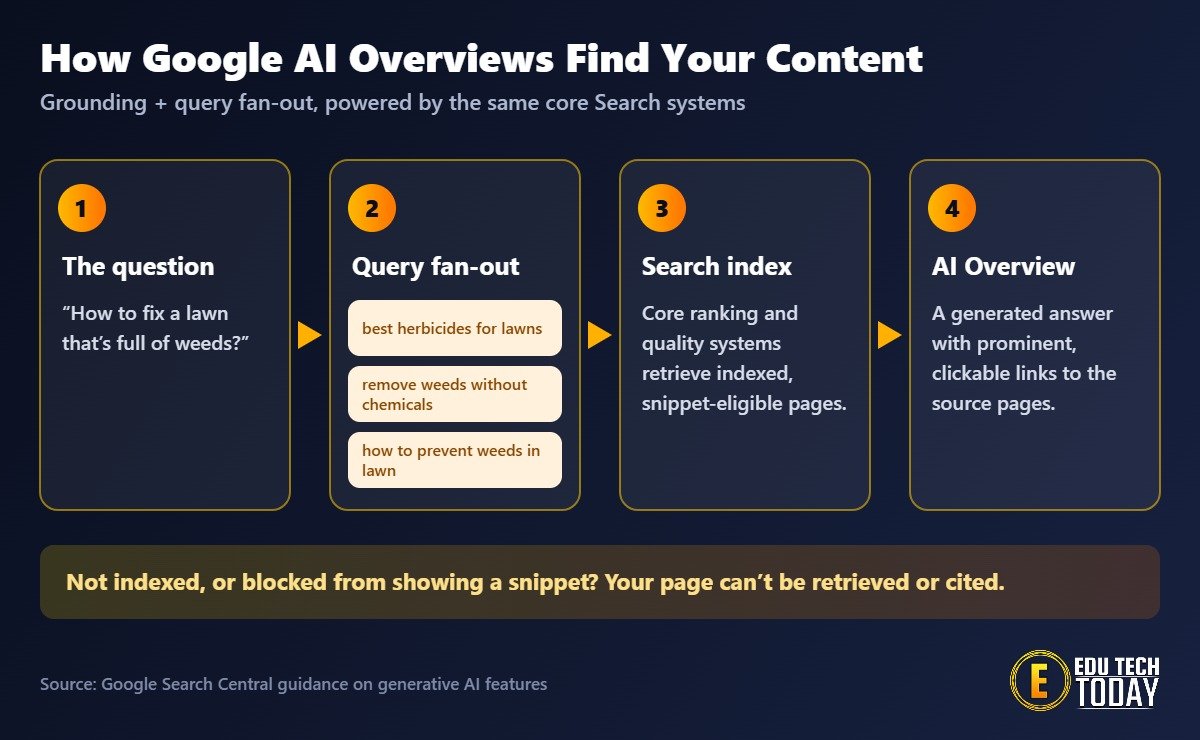
For publishers, the lesson is simple. Pages that cover a topic thoroughly, including the natural follow-up questions, have more chances to match those related searches. That isn’t a new tactic, though. It’s what good topical content has always done.
What GEO and AEO Mean (and Where They Fit)
GEO and AEO aren’t scam terms, and they aren’t meaningless either. Instead, they’re industry labels for a real kind of work:
- AEO (answer engine optimization): making your content easy to use as a direct answer.
- GEO (generative engine optimization): helping AI-generated responses use and cite your content.
Both terms describe efforts to improve visibility in AI-powered search. Even so, from Google’s point of view, optimizing for generative AI search is still SEO. For a side-by-side breakdown, read our guide to SEO vs AEO vs GEO.
So treat GEO and AEO as useful shorthand for part of your SEO work. That includes writing clear answers, covering related questions and being easy to cite. If an agency sells them as a completely separate service, ask what it would do differently, and why.
One caveat is worth adding. Google’s guidance covers Google Search only. ChatGPT, Perplexity and other assistants run their own systems, so it’s still worth checking how AI assistants see your business.
Can Your Pages Appear in AI Overviews? 3 Eligibility Checks
Before you think about strategy, check the basics. According to Google, a page needs to meet three conditions before its generative AI features can use it:
- It’s indexed. Google has crawled the page and added it to the Search index.
- It can show a snippet. No
nosnippetor overly tightmax-snippetdirective blocks it. - It isn’t excluded from generative AI features. If Search Console shows you a Search generative AI setting, make sure it doesn’t exclude your site.
Meeting these conditions doesn’t guarantee a citation, and Google makes no such promise. However, Google can’t consider a page that fails them. Many “AI visibility problems” turn out to be indexing or snippet problems, such as a stray noindex tag.
SEO for AI Overviews: 4 Things That Move the Needle
Once the basics are in place, focus on work that helps both readers and search systems. These four areas matter most.
1. Create non-commodity, people-first content
Google recommends valuable, people-first content that goes beyond common knowledge. In practice, that means you should:
- Offer a clear point of view.
- Share first-hand experience, such as what you tested, built or learned.
- Organise content so readers find what they need quickly.
- Add images or video only where they genuinely help.
- Say something a summary of the top ten results couldn’t.
If an AI system can rebuild your page from general knowledge, searchers have little reason to click. On the other hand, original data, real examples and hard-won expertise give them a reason to visit.
2. Cover the topic, not just the keyword
Because of query fan-out, a single-keyword mindset is limiting. Instead, think about the person’s whole task. What would they ask next? Which objections would they raise? And what do they need to decide?
A useful approach looks like this:
- Answer the main question clearly near the top of the page.
- Map the related questions, such as costs, comparisons, mistakes, alternatives and next steps.
- Cover them on the same page or in a well-linked cluster of pages.
If you want a second opinion on your opening answer, try our free Answer Block Checker. That said, write for the reader first. Don’t pad pages with extra questions just to chase fan-out.
3. Keep the technical foundation clean
Google also asks site owners to keep a clear technical structure. Specifically, that covers:
- Crawling and indexing: search engines can find and index your important pages.
- Page experience: pages are fast, stable and easy to read.
- Mobile-friendly design: essential for mobile-first audiences, especially in India.
- Low latency: faster responses help users and crawlers alike.
- Less duplicate content: you merge near-identical pages into one.
- JavaScript handling: if key content loads only after scripts run, check that Google can still see it.
None of this is glamorous. Still, it’s the plumbing that every search feature depends on.
4. Use structured data sensibly
Structured data isn’t required for AI Overviews or AI Mode. Even so, it remains useful for broader SEO. It helps search engines understand your content, and it can make pages eligible for rich results in classic Search.
Therefore, use markup that matches your visible content and keep it up to date. For local businesses, our LocalBusiness schema generator is a quick starting point. Just remember that more markup isn’t better, and extra schema won’t unlock AI features.
What You Don’t Need to Do
A lot of AI search advice online is noise. According to Google Search Central, you don’t need any of the following for its generative AI features:
- llms.txt files or other AI-only files
- Special “AI markup”
- Content chunking, meaning splitting pages into artificial pieces for AI systems
- AI-specific rewrites of content that already serves readers
- Inauthentic mentions, such as manufactured citations or fake brand buzz
- Excessive structured data
Similarly, some tactics can actively hurt you. Don’t publish AI-only content at scale, and don’t mass-produce thin pages for every fan-out query. Google can treat that as scaled content abuse. Also, don’t stuff keywords or fabricate mentions. These shortcuts are manipulative, and they work against the trustworthy content Google’s systems reward.
A Practical Checklist for AI Overviews
Eligibility
- Google has indexed your key pages (check the Pages report in Search Console).
- No snippet directive blocks your important pages.
- Search Console doesn’t exclude your site from generative AI features.
Content
- Each page answers its main question clearly and early.
- It offers original insight, first-hand experience or data.
- It covers related questions where they genuinely help.
- Images and video add value, not decoration.
- Facts are accurate and up to date.
Technical
- Pages are crawlable, mobile-friendly and fast.
- You’ve merged duplicate pages.
- Google can see content that JavaScript renders.
- Structured data matches the page and validates.
Measurement
- Track impressions, clicks and conversions, not just rankings.
- Review which queries bring qualified visitors, since AI features change how people click.
Frequently Asked Questions
Is SEO dead because of AI Overviews?
No. AI Overviews draw on pages from Google’s Search index and use its core ranking systems. So good SEO is still the main way to earn visibility and citations in them.
How do I get my website cited in AI Overviews?
Good SEO for AI Overviews starts with the three eligibility checks above. Next, publish content that answers the question clearly, adds original expertise and covers related questions. However, no one can guarantee a citation, so be wary of anyone who promises one.
Do I need an llms.txt file for Google AI Overviews?
No. Google says llms.txt files and special AI markup aren’t needed for its generative AI features. Other AI tools may treat these files differently, though, so decide based on where your audience searches.
What’s the difference between GEO and AEO?
AEO focuses on being the direct answer to a question. GEO, by contrast, focuses on being used and cited in AI-generated responses. For Google Search, both fall under SEO.
So, What Should You Call It?
Call it whatever helps your team communicate. If “GEO” or “AEO” helps a stakeholder understand that you’re optimizing for AI-powered search, use the label. Just don’t treat it as a separate strategy that means abandoning what already works.
The way people find information keeps changing. Yet the principle behind it doesn’t: make genuinely useful content, make it easy for search systems to understand and earn trust over time. No one can promise you a spot in an AI Overview. But the sites best placed to benefit are the ones that have done good SEO all along.
SEO isn’t dead. It’s just getting asked harder questions.
Related reading: the nine writing rules for content that gets cited by AI, backed by Princeton research.
Running a medical practice? Our medical practice marketing service handles AI Overviews visibility, Google Business Profile, reviews and SEO for US physician practices.
Want to know if AI Overviews can use your pages? Get a clear view of what’s holding your site back in Google’s AI features, and what to fix first. Book an AI visibility audit.