
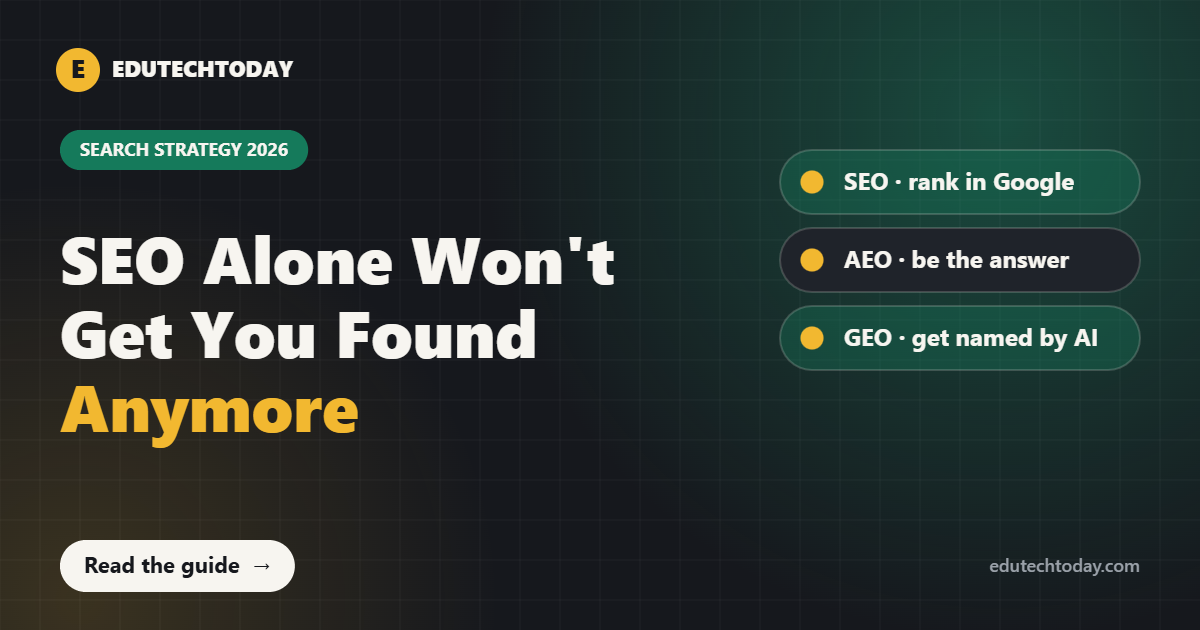
Short answer: SEO helps your pages rank in Google’s results. AEO (answer engine optimization) puts your content into AI Overviews, featured snippets and answer boxes. GEO (generative engine optimization) earns your brand citations inside AI assistants like ChatGPT, Gemini, Claude and Perplexity. All three stand on the same foundation: crawlable, trustworthy, clearly structured content.
Key takeaways
- SEO, AEO and GEO aren’t three separate projects. AEO and GEO sit on top of SEO. So if search engines can’t crawl and index a page, nobody can quote it.
- Google says there’s no special markup or “AI file” needed to appear in AI Overviews or AI Mode. In other words, Google has to index the page, and it must qualify to show with a snippet.
- Answer engines reward pages that answer the question in the first few lines. Generative engines reward brands that are easy to identify, verify and quote.
- Blocking the wrong crawler can quietly remove you from AI answers. For ChatGPT search, the one that matters is OAI-SearchBot, not GPTBot.
What is SEO?
SEO (search engine optimization) is the work of earning rankings in Google’s organic results: making pages crawlable, matching them to what people actually search, and building enough authority that Google trusts your page over a competitor’s. For most B2B sites it is still the volume engine.
In practice that means keyword research grouped into topic clusters, a pillar-and-spoke site structure, internal links that tell Google which page owns which topic, and boring-but-vital technical health: indexation, speed, sensible canonical tags. None of that has gone away. What has changed is that a ranking is no longer the only place a buyer meets your content.
What is AEO?
AEO (answer engine optimization) is structuring content so a search engine can lift a direct answer from it into an AI Overview, a featured snippet, a “People also ask” box or a voice result. The goal isn’t only the click. Instead, it means being the source that the answer draws on.
Answer engines read in a predictable way: they look for a question, then a clean, self-contained answer right underneath it. So AEO is mostly editorial discipline:
- Use the question people actually ask as the heading.
- Answer it in the first 40–60 words, in plain language, with no “it depends” warm-up.
- Then go deeper with steps, examples and edge cases.
- Mark up genuine FAQs and how-tos with schema, and keep that markup identical to what’s visible on the page.
That last point isn’t a personal preference. Google’s guidance for its AI features says structured data should match the visible text on the page.
What is GEO?
GEO (generative engine optimization) is making your brand and expertise easy for large language models to find, understand and cite when they generate an answer. AEO asks, “Can you quote this paragraph?” GEO asks, “Do you know who this company is, what it’s an authority on, and whether it can be trusted?”
Generative engines assemble answers from many sources at once. In practice, the brands that AI names tend to have five things in common:
- Entity clarity: one consistent description of who you are and what you do, repeated on your site, your profiles and your directory listings.
- Quotable definitions: short, specific statements a model can lift without rewriting, like the answer at the top of this article.
- Verifiable authorship: a real person with a byline, an author page and a track record.
- Corroboration: other credible sites saying the same things about you.
- Crawl access: your site lets in the crawlers that feed AI search features.
SEO vs AEO vs GEO at a glance
| SEO | AEO | GEO | |
|---|---|---|---|
| Where you show up | Google organic results | AI Overviews, featured snippets, answer boxes | ChatGPT, Gemini, Claude and Perplexity answers |
| What you win | Rankings and clicks | Being the quoted answer | AI names and cites you |
| Unit of optimization | The page | The answer block | The entity: your brand and your authors |
| Main levers | Keywords, clusters, internal links, technical health | Question headings, 40–60 word answers, FAQ and HowTo schema | Consistent entity data, definitions, authorship, corroboration, crawler access |
| Typical failure | Thin pages competing for the same keyword | The answer hides in paragraph six | Nobody can tell who you are or why to trust you |
SEO vs AEO vs GEO: do you need all three?
If your buyers research before they buy, and in B2B they almost always do, then yes. But not as three budgets. Treat it as one content system with three outputs.
The order matters. SEO comes first because an AI Overview can only use a page Google has indexed and considers eligible for a snippet. AEO is mostly about how you write and format that page. GEO is about how consistently and credibly your brand shows up across the web. Work in that order and each layer makes the next one cheaper.
Does Google require special markup for AI Overviews?
No. Google’s documentation says there are no additional requirements and no special optimizations needed to appear in AI Overviews or AI Mode: no new schema type and no AI-specific text file. Google needs to index a page, and it must qualify to appear with a snippet, and the usual best practices apply. Allow crawling, link to important pages internally, keep key content in text, and make structured data match what’s on the page.
That’s good news. It also means anyone selling a secret “AI Overview markup” is selling something Google says doesn’t exist.
Which AI crawlers should you allow?
For ChatGPT search, the crawler that matters is OAI-SearchBot. OpenAI says ChatGPT search won’t show sites that block it in its answers. GPTBot is different: it collects content that OpenAI may use to train OpenAI’s models, and blocking it doesn’t affect whether you appear in search.
So “block all AI bots” is a business decision, not a safe default. If you want AI to recommend you, check your robots.txt, your CDN’s bot settings and any security plugin, because any of them can block OAI-SearchBot without you noticing. On Google’s side, Google-Extended is a separate control that limits use of your content for AI training and grounding in some of Google’s other systems. It isn’t how you opt in or out of Search. You can check your own setup in a minute with our free AI Crawler Checker.
Where to start: a 30-day order of work
- Week 1: make sure crawlers can read you. Check indexation in Google Search Console, confirm robots.txt and your CDN allow Googlebot and OAI-SearchBot, and fix anything that hides important text behind scripts or images.
- Week 2: define yourself once. Write a one-sentence description of your company and use it on your homepage, About page, LinkedIn and directory listings. Add Organization and Person schema that says the same thing.
- Week 3: rewrite your top pages answer-first. Take the five pages that matter most to pipeline. Put the buyer’s question in the heading and the answer in the first 60 words.
- Week 4: show who’s behind it. Add real bylines, an author page with credentials, visible dates and citations to primary sources.
None of this is glamorous. That’s exactly why it works: most competitors skip it.
Frequently asked questions
Is AEO just SEO with a new name?
Partly. AEO uses the same foundations as SEO, but it aims for a different result: being the quoted answer rather than a blue link. A page can rank on page one and still never appear in an AI Overview if its answer hides halfway down.
Is GEO the same as AEO?
No. AEO is about extractable answers on search results pages. GEO is about whether generative assistants such as ChatGPT and Perplexity recognise and cite your brand at all, which depends more on entity consistency, authorship and corroboration across the web.
Do I need llms.txt or special AI files to appear in AI Overviews?
Not for Google. Google states that you need no new machine-readable files, AI text files or special schema to appear in AI Overviews or AI Mode. Clean, crawlable pages and accurate structured data do more.
How long does it take to see results?
Plan on around 90 days for early traction and roughly six months before results compound, depending on your site’s current authority and competition. Crawler and markup fixes can show up sooner because they remove blockers rather than build authority.
Sources
- Google Search Central: AI features and your website
- OpenAI: Overview of OpenAI crawlers
- Google Search Central: Creating helpful, reliable, people-first content
Want to know which of the three is holding your content back? Book a free content audit: a 30-minute call and a 5-page written report.