
Short answer: An AEO and GEO content strategy is a plan for publishing pages that answer real questions in a format search engines can quote, and that AI assistants such as ChatGPT, Gemini and Google AI Overviews can trust and cite. It starts with the questions buyers ask, puts a direct answer at the top of every section, and backs each claim with evidence.
Most content plans I audit were built for a search page that no longer exists. They chase one keyword per post, stack 2,000 words of background before the point, and then wonder why the traffic graph is flat. So this guide lays out the AEO and GEO content strategy framework I use at EduTechToday, step by step, with the research behind each step.
Key takeaways
- Rankings still matter, but they no longer guarantee a citation. In fact, most AI Overview citations now come from pages outside the top 10.
- Answer engines reward pages that open with a clear, short answer and then prove it.
- Generative engines reward evidence: statistics, named sources and quotations.
- Keyword stuffing doesn’t help with AI answers. In one study, it actually performed worse than doing nothing.
- Therefore, plan content around question clusters, not single keywords.
What is an AEO and GEO content strategy?
Think of it as three jobs for every page. First, the page has to rank, which is classic SEO. Second, it has to be the answer that gets lifted into a featured snippet, a voice reply or an AI Overview. That is answer engine optimization (AEO). Third, it has to be a source that large language models mention and link to when they write a response. That is generative engine optimization (GEO).
If the terms are new to you, my earlier guide on SEO vs AEO vs GEO explains each one in plain English. This post is the practical follow-up: how to plan, write and measure content that does all three jobs at once.
Why old content plans fall short in 2026
Search behavior has shifted fast. For example, SparkToro’s analysis of US Google searches from January to April 2026 found that about 68% ended without a single click, up from roughly 60% in 2024. The same report notes that AI Overviews appear on more than one in five searches, and that click-through rates fall sharply when they do.
Meanwhile, the link between ranking and being cited has weakened. Ahrefs studied 863,000 keywords and 4 million AI Overview URLs and found that only 38% of cited pages also ranked in the top 10. A year earlier, that figure was 76%. In other words, a page ranking on page two can still earn the citation if it answers the question better.
Outside Google, the audience keeps growing too. OpenAI said in February 2026 that ChatGPT has about 900 million weekly users. That is a huge number of buyers asking questions where a blue link list never appears.
The 5-layer AEO and GEO content strategy framework
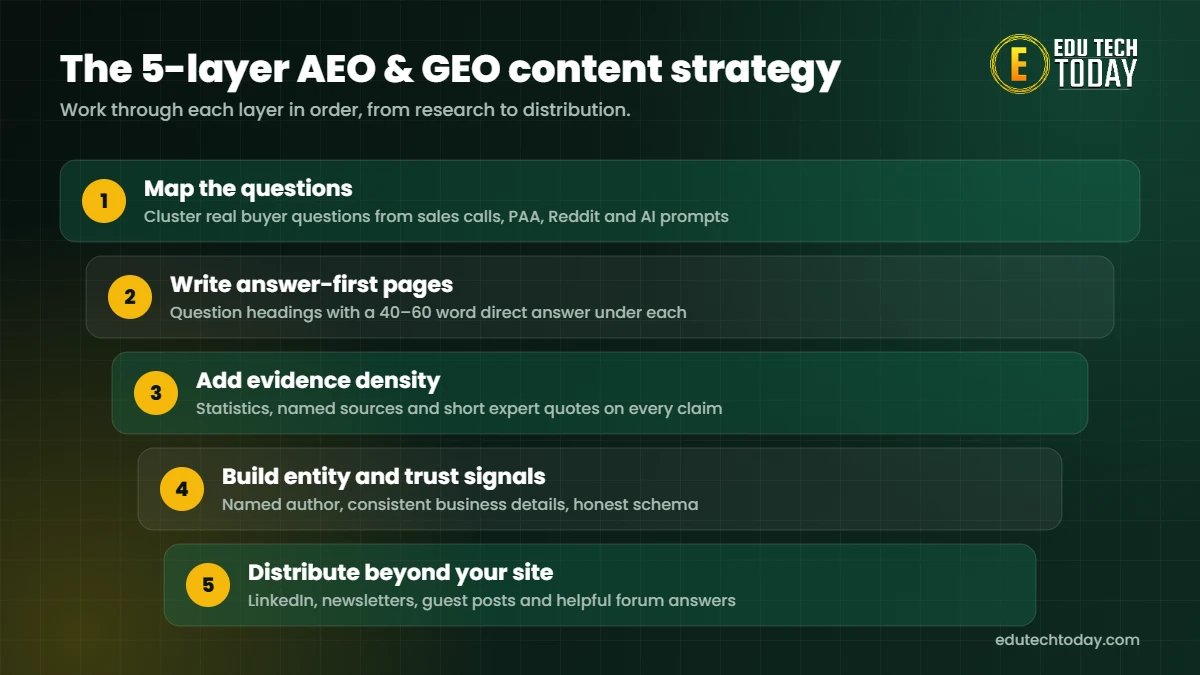
Here is the framework I use with clients. Each layer builds on the one before it, so work through them in order.
Layer 1: Map the questions, not just the keywords
Start with what your buyers actually ask. Pull questions from sales calls, support tickets, the “People also ask” box, Reddit threads and the prompts people type into ChatGPT. Then group them into clusters. Each cluster becomes one strong page, not five thin ones.
This matters because Google’s AI features use what it calls query fan-out. Put simply, the system runs several related searches across subtopics before it writes a summary. As a result, a page that covers the whole cluster has more chances to be pulled in.
Layer 2: Write answer-first pages
Every H2 should be phrased the way a person would ask it. Then the first two or three sentences under it should answer the question directly, in 40 to 60 words. After that, you can add context, examples and nuance.
I call these answer blocks. They are easy for an answer engine to lift, and they also help human readers who skim. You can test your own drafts with our free answer block checker.
Layer 3: Add evidence density
This is the layer most teams skip, and it is where the research is clearest. A 2024 study from Princeton University and IIT Delhi tested nine ways of rewriting content for generative engines. Adding quotations, adding statistics and citing sources were the top performers, lifting visibility by up to about 40%. By contrast, keyword stuffing scored below the unedited baseline.
So give every major claim a number, a named source or a short expert quote. Original data works best of all, because no one else has it.
Layer 4: Build entity and trust signals
AI systems need to know who is speaking. Use a real author with a bio, link to their profile, and keep your business name, services and location consistent everywhere. My guide on E-E-A-T for B2B content covers the trust signals in detail.
Also, keep structured data honest. Google states plainly that there is no special schema you need for AI Overviews. However, it does ask that any structured data you add matches the visible text on the page.
Layer 5: Distribute beyond your own site
Generative engines learn about brands from the wider web, not only your blog. Therefore, repurpose each pillar page into a LinkedIn article, a short newsletter issue, a guest post or a helpful forum answer. Each mention is another signal that your brand is a known source on the topic.
How to plan your AEO and GEO content calendar
Once the framework is clear, turn it into a calendar. I usually recommend a mix of four content types, because each one does a different job.
| Content type | Main job | AEO element | GEO element |
|---|---|---|---|
| Pillar guide | Own a broad topic | Definition block at the top | Original framework and data |
| Comparison post | Win “X vs Y” queries | Comparison table | Named sources for each claim |
| How-to guide | Win process queries | Numbered steps | Real client example |
| FAQ or glossary page | Catch long-tail questions | Short Q&A pairs | Consistent entity details |
A realistic pace for a small team is one pillar or comparison post and two supporting posts each month. Then link every supporting post back to its pillar, and link the pillar to your main service page.
What to measure in a GEO content strategy
Traffic alone will understate your results, because many AI answers send no click. Instead, track a small set of signals every month:
- Impressions in Search Console. Google counts AI Overview and AI Mode appearances in the regular “Web” performance report.
- Citation checks. Ask ChatGPT, Gemini and Perplexity your ten most important buyer questions, then log whether your brand is named or linked.
- Branded search growth. When AI tools mention you, people often search your name next.
- Lead quality. Ask new leads where they first heard of you, and add “an AI assistant” as an option.
Our free AI visibility tools can speed up some of these checks.
Common content strategy mistakes for AEO and GEO
- Burying the answer. If the reader needs to scroll past three paragraphs of history, an answer engine will usually skip you too.
- Publishing thin AI drafts. Unedited AI text rarely contains the original evidence that earns a citation.
- Splitting one topic across many pages. Five weak posts compete with each other, while one strong page wins.
- Ignoring off-site mentions. Your blog alone is rarely enough to make an AI system trust your brand.
- Chasing special files or tricks. Google says you don’t need new machine-readable files or special markup to appear in its AI features.
If you want a team to run all five layers for you, that is exactly what we do as an SEO, AEO & GEO content strategy studio.
Frequently asked questions
Is an AEO and GEO content strategy different from SEO?
It builds on SEO rather than replacing it. Your pages still need to be crawlable, indexed and useful. The difference is in the format and the evidence: answer-first sections for AEO, and statistics, sources and quotes for GEO.
How long does it take to get cited by AI Overviews or ChatGPT?
For an established site, well-structured pages can start appearing within a few weeks of being indexed. For a newer site, expect two to four months, because trust and off-site mentions take longer to build.
Do I need schema markup for AI search?
Not specifically. Google says no special schema is required for AI Overviews or AI Mode. Still, accurate Article, FAQ and Organization markup helps search engines understand your page, as long as it matches the visible content.
How many blog posts do I need?
Fewer than most people think. One strong pillar page per topic cluster, supported by two to four focused posts, usually beats a high volume of thin articles.
Next, read our companion guide on how to write content that gets cited by AI. Healthcare teams can jump to our playbook on AI visibility for medical practices.
Sources
- SparkToro zero-click data for 2026, reported by TechWyse
- Ahrefs study on AI Overview citations and top 10 rankings, reported by DesignRush
- GEO: Generative Engine Optimization (Aggarwal et al., KDD 2024)
- Google Search Central: AI features and your website
- eWeek: ChatGPT reaches about 900 million weekly users
Running a busy practice? See how our our medical practice marketing service handles this work every month, so your team does not have to.
Not sure where your content stands with AI search? Book a free content audit: a 30-minute call and a 5-page written report.