
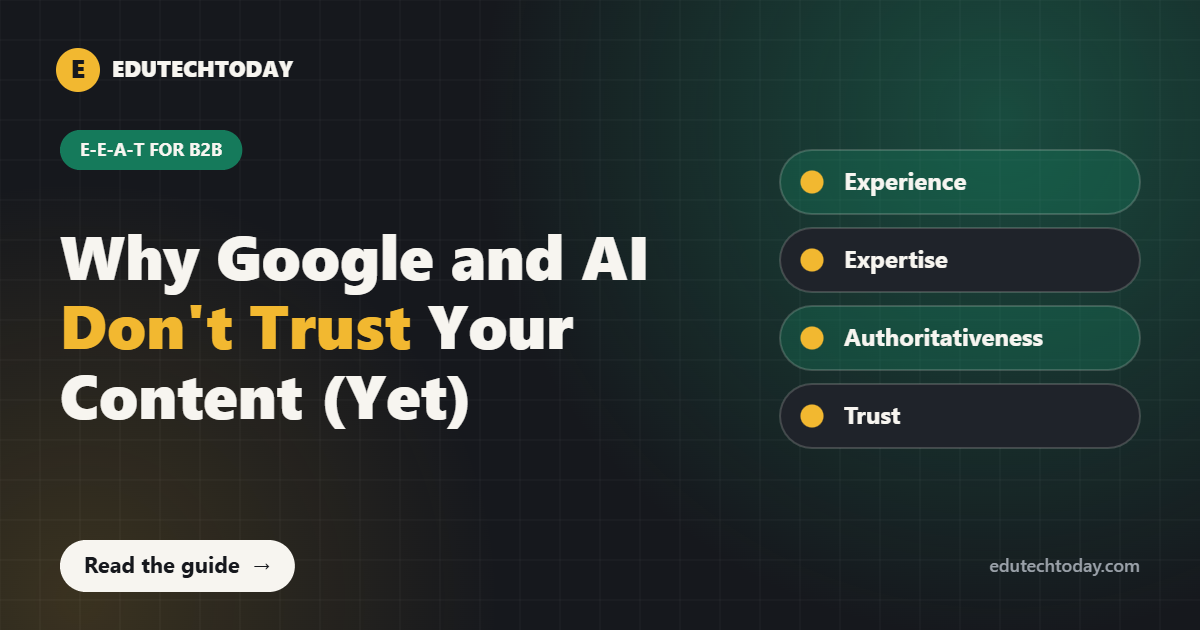
Short answer: E-E-A-T stands for Experience, Expertise, Authoritativeness and Trustworthiness, the qualities Google’s systems try to reward in helpful content. It isn’t a single ranking factor. For B2B teams it works best as a build spec: named authors, verifiable credentials, first-hand evidence, dated content and cited sources, all marked up so search engines and AI assistants can check them.
Key takeaways
- Google says that of the four, trust matters most.
- E-E-A-T isn’t a direct ranking factor. It describes what Google’s systems look for, so you improve it through signals, not a setting.
- Google strongly encourages accurate bylines that lead to background on the author, and calls fake author profiles deceptive.
- The same signals help generative engines decide whether you’re a source worth citing.
What does E-E-A-T stand for?
E-E-A-T is Experience, Expertise, Authoritativeness and Trustworthiness. In plain terms: has the author actually done this, do they know the subject, is the site a recognised reference on it, and can the reader rely on what it says? Google uses the framework to describe the kind of content its ranking systems aim to surface.
- Experience: first-hand involvement. A RevOps lead writing about the attribution model they built, not a generalist summarising other blog posts.
- Expertise: knowledge and skill in the subject, shown through credentials, depth and accuracy.
- Authoritativeness: being a go-to source on the topic, which shows up as depth of coverage and other credible sites referencing you.
- Trustworthiness: accuracy, honesty, transparency and safety. Google calls this the most important of the four.
Is E-E-A-T a ranking factor?
Not in the way people often claim. Google states that E-E-A-T itself isn’t a specific ranking factor, but its systems use a mix of signals that line up with good experience, expertise, authoritativeness and trust. So there’s no E-E-A-T switch to flip. You earn it by making those qualities obvious to readers and easy for machines to verify.
That’s why I treat it as an engineering requirement rather than a writing style. “Sound more authoritative” isn’t actionable. “Every article has a named author whose page lists their credentials and links to their LinkedIn” is.
Why does E-E-A-T matter for AI search?
AI Overviews and assistants such as ChatGPT and Perplexity build answers from sources they can find and parse. When two pages say similar things, the one with a clear author, a clear organisation behind it and claims that check out is the safer one to use. You can’t control which source a model picks, but you can remove every reason for it to doubt yours.
The practical overlap with GEO is large: consistent entity information, verifiable authorship and corroboration across the web are both E-E-A-T signals and the things that make a brand easy to cite.
The E-E-A-T for B2B content build spec
Here’s the checklist I use. Each signal has a visible part for readers and a machine-readable part for search engines.
| Signal | What readers see | What machines read |
|---|---|---|
| Named author | A byline with a real name on every article | Person schema linked to an author page, with sameAs pointing to LinkedIn |
| Credentials | A short bio: role, years of experience, specific areas | jobTitle and knowsAbout on the Person entity |
| First-hand experience | Original screenshots, data, process notes, decisions and trade-offs | Original images with descriptive alt text; content not found elsewhere |
| Freshness | A visible “updated” date on content that changes | datePublished and dateModified that match reality |
| Sources | Links to primary documentation, standards and data | Outbound links to authoritative domains |
| Organisation identity | A clear About page, contact details and a consistent company description | Organization schema with the same name, logo and description everywhere |
| Transparent process | A note on how the content was made, including any AI use | Nothing to mark up. This one is for humans |
How should you disclose AI use in content?
Explain it where a reader would reasonably wonder how something was made. Google asks publishers to be clear about automation and AI use in those situations, and says using automation mainly to manipulate rankings breaks its spam policies. Mass-producing pages without human oversight counts as little to no effort.
A simple line works: “Drafted with AI assistance, then rewritten and fact-checked by [author].” What matters more is that a qualified person genuinely shaped and checked the piece.
The “Who, How, Why” test before you publish
Google suggests three questions, and they make a good final check on any B2B article:
- Who created it? Is there a byline, and does it lead to real background on the author?
- How was it created? Would a reader understand the process, including any automation, where it matters?
- Why does it exist? Is it mainly here to help someone, or mainly here to attract search traffic? Google calls this perhaps the most important question.
Common mistakes with E-E-A-T for B2B content
- “Admin” or a company name as the author. Nobody can verify a byline that isn’t a person.
- Invented personas. Made-up names, stock or AI-generated headshots and fictional credentials are exactly what Google describes as deceptive.
- Undated evergreen pages. If a page about AI search hasn’t changed in two years, readers and machines both have reason to doubt it.
- Claims without sources. “Grew traffic 300%” with no context, no data and no client name does more harm than good.
- Schema that says more than the page. Structured data should describe what’s visible, not what you wish were on the page.
Frequently asked questions
Is E-E-A-T a Google ranking factor?
Not directly. Google says E-E-A-T itself isn’t a specific ranking factor. Its systems use a mix of signals to identify content that shows good experience, expertise, authoritativeness and trust, so improving those signals still matters.
Can AI-assisted content have strong E-E-A-T?
Yes, if a qualified person shapes, checks and stands behind it. Google asks publishers to explain how automation was used where readers might wonder, and treats mass-produced content without human oversight as low effort.
Do I really need an author page?
For B2B content, yes. Google strongly encourages bylines that lead to background on the author. An author page with a real bio, credentials and links to profiles is the simplest way to make expertise verifiable.
How do I show experience if I cannot name clients?
Show the work instead of the logo: your method, anonymised before-and-after examples, original screenshots, your own data and the decisions you made. Name clients only with permission.
Sources
- Google Search Central: Creating helpful, reliable, people-first content
- Google Search Central: AI features and your website
Want to know where your content loses trust? Book a free content audit: a 30-minute call and a 5-page written report.