
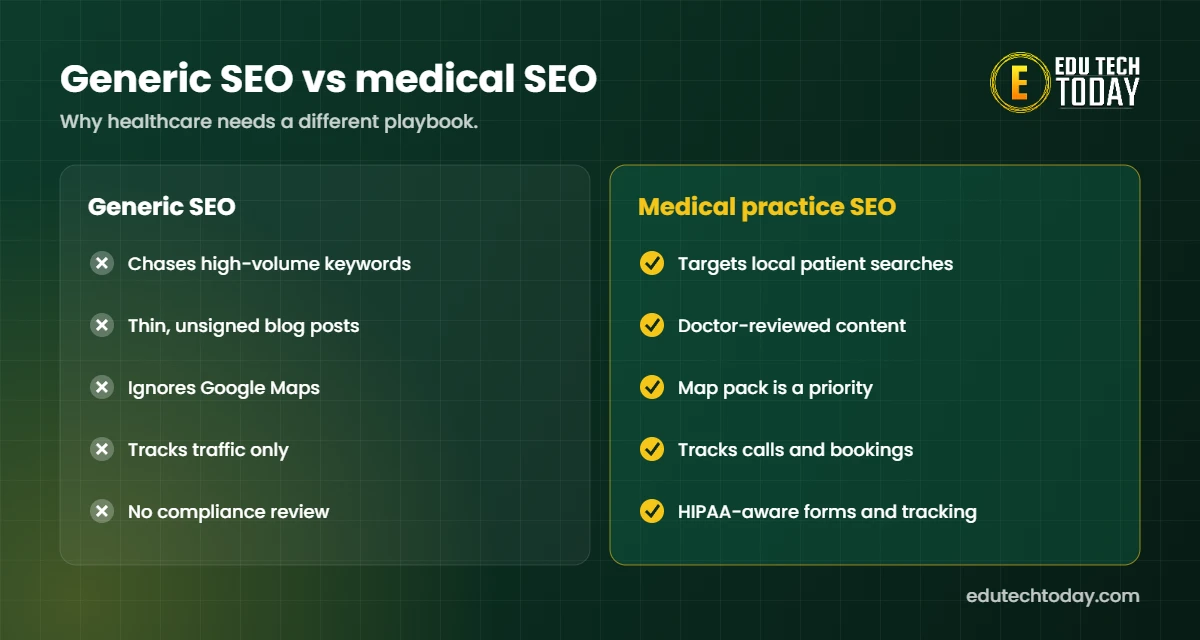
SEO for doctors is the work that helps patients find your practice on Google and in AI answers. It combines a strong Google Business Profile, a fast website with one page per service, trusted doctor-reviewed content, and steady reviews and citations. Because most patients search locally, map rankings usually matter most.
Patients search for care the same way they search for anything else. For example, they type “knee pain doctor near me” or ask ChatGPT for the best pediatrician in town. Good SEO makes sure your practice is the answer they see.
What is SEO for doctors?
Search engine optimization improves how often your practice appears for the searches patients make. For medical practices, that includes three places. First, the Google map pack. Second, the regular search results. Third, AI answers from Google, ChatGPT, Gemini and Perplexity.
Why SEO for doctors matters more in 2026
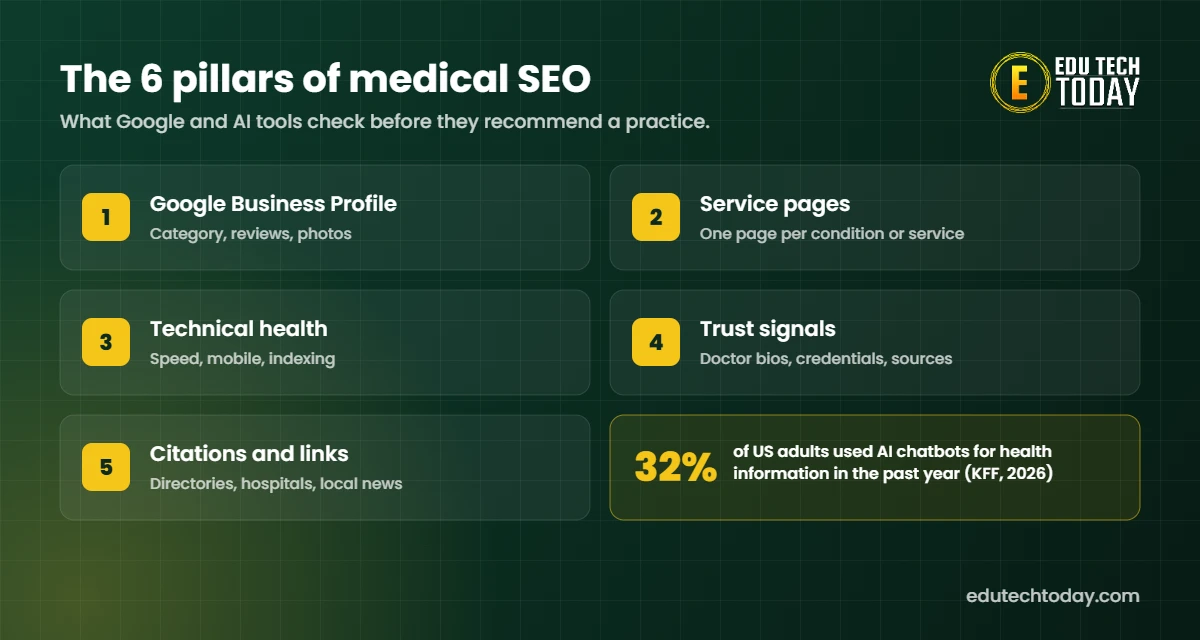
Patients now research care in more places. According to a 2026 KFF poll, about a third of US adults used AI chatbots for health information in the past year. At the same time, Google search and Maps remain the main path to booking. So your practice needs to show up in both.
The six pillars of SEO for doctors
1. Google Business Profile: Above all, this drives map rankings, calls and directions. Start with our Google Business Profile guide for doctors.
2. Service and condition pages: Ideally, give each service its own page. For example, “migraine treatment” and “sports injury care” should not share one page.
3. Technical health: The site must be fast, mobile friendly and easy for Google to crawl. If it is not, a website redesign may be the fastest fix.
4. Trust signals: Also show who wrote and reviewed each page, with credentials. Google asks creators to show this kind of experience in its guide to helpful, people-first content.
5. Citations and links: Keep your details consistent on Healthgrades, insurance directories and hospital sites. In addition, earn links from local news and community groups.
6. Reviews: Likewise, a steady flow of new reviews supports both rankings and trust.
How to do keyword research for a medical practice
To begin with, list what patients actually type. Usually that means a service plus a place, such as “ADHD testing Dallas”. Then add symptom searches, such as “why does my heel hurt in the morning”. Finally, list the questions your front desk hears every week. Each common question can become a page or a FAQ answer.
SEO for doctors in AI search
AI tools prefer clear, direct answers from trusted sources. So open each page with a short answer, then add detail. Also use structured data, as we explain in our medical practice schema guide. For more depth, read how AI Overviews choose medical practices and how to earn ChatGPT citations.
How long does medical SEO take?
Profile and on-page fixes can lift map visibility within weeks. However, content and links usually need three to six months to show steady growth. Google’s own SEO starter guide also notes that changes take time to appear.
Do it yourself or get help with SEO for doctors?
Certainly, you can handle the basics in-house. Even so, most practices struggle to keep content, reviews and technical fixes moving every month. If that is your situation, compare the costs in our guide on whether to outsource practice marketing. Or see how our healthcare marketing team runs search for practices like yours.
Frequently asked questions
What is SEO for doctors?
It is the process of improving how often a medical practice appears in Google Maps, Google search results and AI answers when patients look for care.
How much does SEO for doctors cost?
Costs depend on competition, specialty and the number of locations. A single-location practice in a small market needs less work than a multi-location group in a large city.
Is local SEO more important than regular SEO for medical practices?
For most practices, yes. Patients usually want care nearby, so map rankings and the Google Business Profile drive most calls.
Do doctors need a blog for SEO?
Not always a blog, but they do need helpful pages. Clear pages for each service and common patient question usually beat generic blog posts.
How do I get my practice recommended by ChatGPT?
Keep your details consistent across trusted directories, earn reviews and mentions, and publish clear answer-first pages with schema markup.
Want a clear SEO plan for your practice? See our medical practice marketing service or book a free SEO and AI visibility audit.