
A medical practice website redesign rebuilds your site so patients can find you, trust you and book quickly. You need one when the site is slow, hard to use on phones, or no longer brings in new patients. Done well, a redesign keeps your Google rankings and adds online booking, clear service pages and HIPAA-safe forms.
Your website is often the second thing a patient checks, right after your Google listing. If it looks dated or loads slowly, they simply go back and call the next practice. That is why a redesign is a growth decision, not just a design project.
What is a medical practice website redesign?
It is a planned rebuild of your site’s structure, content and design. A refresh changes colors and photos. A redesign, however, also fixes the pages, the speed, the forms and the tracking. As a result, it changes how many visitors turn into booked patients.
12 signs you need a medical practice website redesign
If three or more of these apply, it is time to plan one.
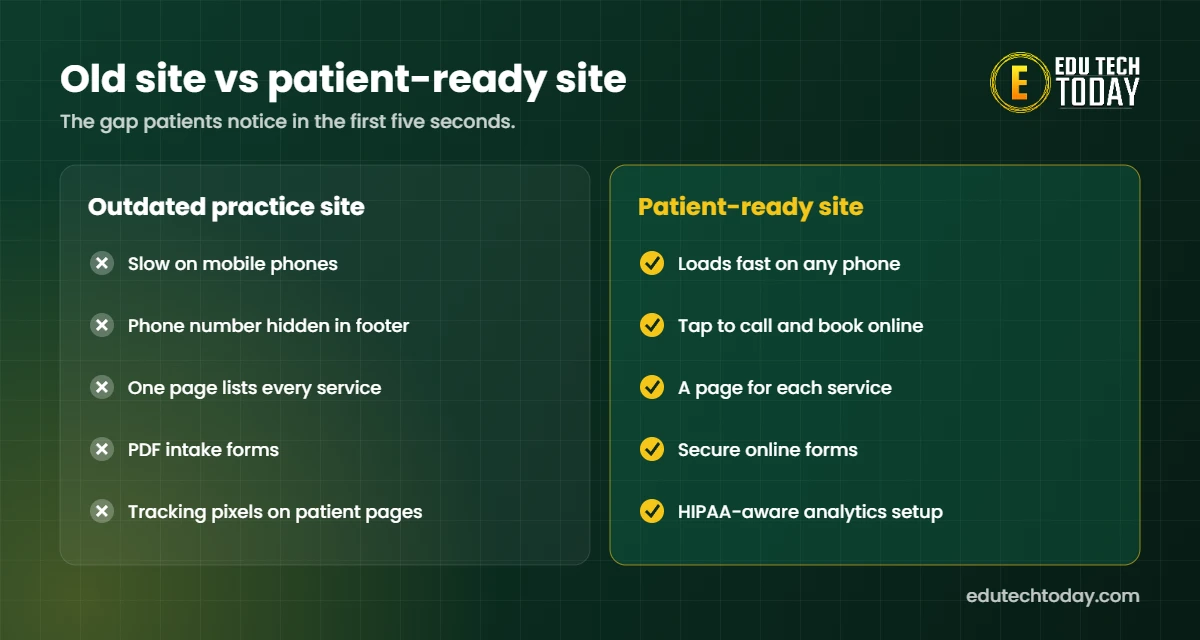
- The site is slow on a phone.
- Patients cannot tap to call.
- There is no online booking or request form.
- All services sit on one long page.
- New doctors or locations are missing.
- Intake forms are printable PDFs.
- The design has not changed in five years.
- Organic traffic keeps falling.
- Staff cannot update pages without a developer.
- Ad or analytics pixels run on patient pages.
- Text is hard to read or lacks alt text.
- Patients say they “could not find” basic information.
What patients expect from a doctor’s website in 2026
Patients want answers fast. First, they look for the services you offer and the insurance you accept. Next, they want your location, hours and a way to book. Finally, they look for proof, such as doctor bios and reviews.
Speed matters too. Google measures real user experience through Core Web Vitals. So a slow site can hurt both rankings and bookings.
Medical practice website redesign cost
Prices vary widely by scope. The ranges below are rough market guides, so always compare at least three quotes.
| Scope | Typical range | Best for |
|---|---|---|
| Template site | $3,000 to $8,000 | Solo practice |
| Custom small site | $8,000 to $25,000 | Growing group |
| Multi-location site | $25,000 and up | Groups and clinics |
Also budget for hosting, content updates and SEO after launch. Otherwise, the new site can stall within a year.
HIPAA, tracking and accessibility rules
Healthcare sites carry extra rules. For example, HHS has warned that some online tracking technologies can expose patient data. Therefore, keep ad pixels off patient portals and appointment forms. Use secure form tools that will sign a business associate agreement.
Accessibility matters as well. The Department of Justice explains how the ADA applies to the web in its web accessibility guidance. In practice, that means readable text, alt text and full keyboard navigation.
How to redesign without losing Google rankings
Redesigns lose traffic when old URLs disappear. To avoid that, list every page that gets visits or links today. Then map each one to its new address with a 301 redirect. In addition, keep the content that already ranks and improve it, rather than deleting it.
Structured data helps too, because it tells Google and AI tools exactly who you are. See our guide to medical practice schema markup and our notes on LLM optimization for medical websites.
Our step-by-step medical practice website redesign process
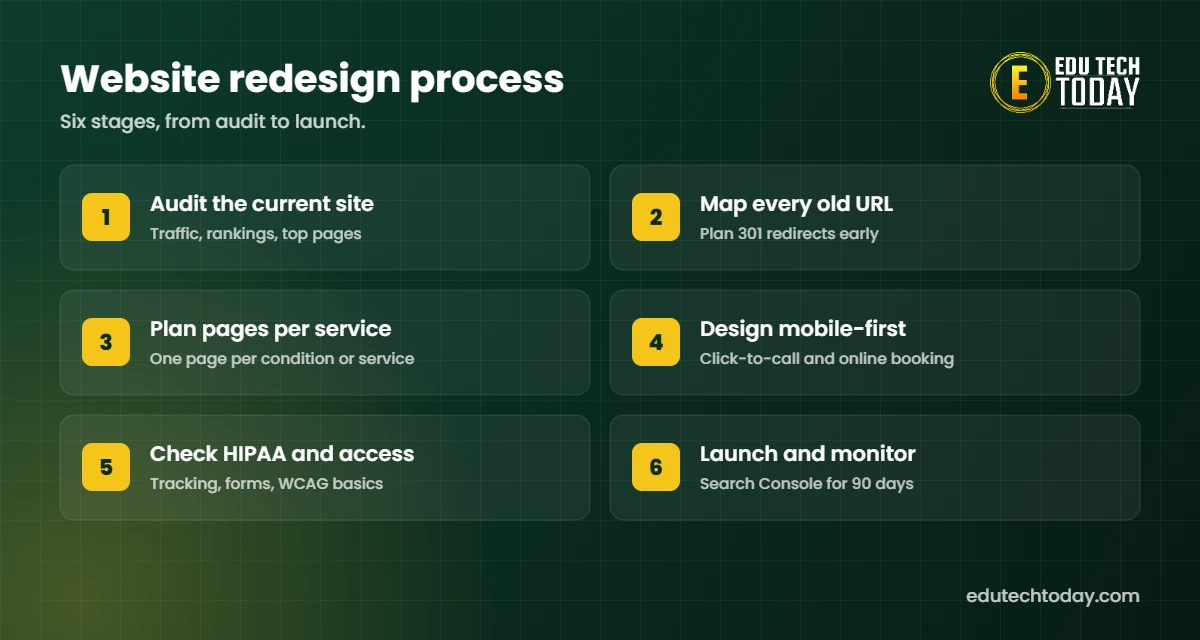
1. Audit: First, we record traffic, rankings and the pages that bring patients.
2. Map: Next, we plan every redirect before design starts.
3. Plan: Then we create one page per service, condition and location.
4. Design: After that, we design for phones first, with tap-to-call and booking on every page.
5. Check: Before launch, we review tracking, forms and accessibility.
6. Launch: Finally, we monitor Search Console for 90 days and fix any issues quickly.
Who should handle your redesign?
A general web designer can build a nice site. However, a healthcare-focused team also knows HIPAA, schema and local SEO. That combination protects rankings while it improves bookings. If you want to compare providers, use our 10 questions to ask any agency. For the search side after launch, read our guide to SEO for physicians.
When you are ready, our healthcare marketing team can plan and build your medical practice website redesign from audit to launch.
Frequently asked questions
How much does a medical practice website redesign cost?
It depends on scope. Template sites often start around $3,000, while custom multi-location sites can pass $25,000. Ongoing hosting and SEO are extra.
How long does a medical practice website redesign take?
Most redesigns take 6 to 12 weeks. Content writing and approvals usually take longer than design.
Will a new website hurt my Google rankings?
Not if you map old URLs to new ones with 301 redirects and keep ranking content. Rankings drop mainly when pages are deleted or moved without redirects.
Does my practice website need to be HIPAA compliant?
Any page that collects patient health information needs secure handling. That includes forms, chat and tracking tools. Brochure pages without patient data carry less risk.
Should I add online booking to my website?
Yes, if your scheduling system supports it. Online booking lets patients act at night or on weekends, when your front desk is closed.
Planning a new site? See how we redesign medical practice websites or book a free website audit.