
Short answer: AI Overviews for medical practices are Google’s AI-written summaries that can cite your pages when patients search health or provider questions. To be eligible, Google must index your pages and be able to show a snippet. To win the citation, your pages need clear answers, visible medical expertise, an accurate Google Business Profile and outside proof such as reviews. A realistic plan takes about 90 days.
Google now answers many health searches with an AI Overview at the top of the page. For patients, that box is often the first and last thing they read. For practices, it raises a hard question: how do you become one of the sources Google cites?
There is no trick for this. Google says plainly that its AI features run on the same foundations as Search. Still, there is a clear path, and it starts with eligibility. This guide explains how AI Overviews pick health sources, what makes a page eligible, and a 90-day plan for AI Overviews for medical practices.
Key takeaways
- Google must index a page and allow a snippet before it can appear in AI Overviews.
- Only 38% of AI Overview citations now come from top-10 pages, so strong answers can win beyond rank.
- Google uses Business Profile data for local businesses in its AI responses.
- Search Console’s generative AI report shows where you already appear.
How AI Overviews choose health sources
First, AI Overviews draw on pages from Google’s index. For health topics, Google applies extra care, because wrong answers can harm people. As a result, it favors pages that show real expertise, cite reliable evidence and come from trusted sites.
Rankings still matter, though less than before. In a March 2026 update, Ahrefs found that 38% of pages cited in AI Overviews also rank in the top 10, down from about 76% in its 2025 study. In other words, a well-structured page on page two can still earn a citation, while a top-ranked but vague page can miss out.
What makes a page eligible for AI Overviews
Google’s documentation lists simple requirements. First, Google must index the page. Second, the page must qualify to show a snippet in Search. Beyond that, Google says no special markup, AI text file or rewritten “AI version” of your content is required.
Therefore, check three things. Is the page indexed in Search Console? Does it avoid nosnippet tags that block summaries? And does it load its main text without relying on scripts that crawlers might skip?
Why AI Overviews for medical practices are harder to win
Health searches compete with giants like Mayo Clinic, Cleveland Clinic and WebMD. For broad questions such as “what causes migraines,” those sites usually win. However, practices have a real advantage on local and specific questions, such as “migraine specialist in Dallas that takes Cigna.” For those, Google leans on Business Profile data, reviews and local pages, where a practice can compete.
That is why our existing guide on SEO for AI Overviews stresses fundamentals. For practices, those fundamentals simply carry a medical layer.
A 90-day plan for AI Overviews for medical practices
Run the plan in three 30-day sprints. Each sprint builds on the one before it.
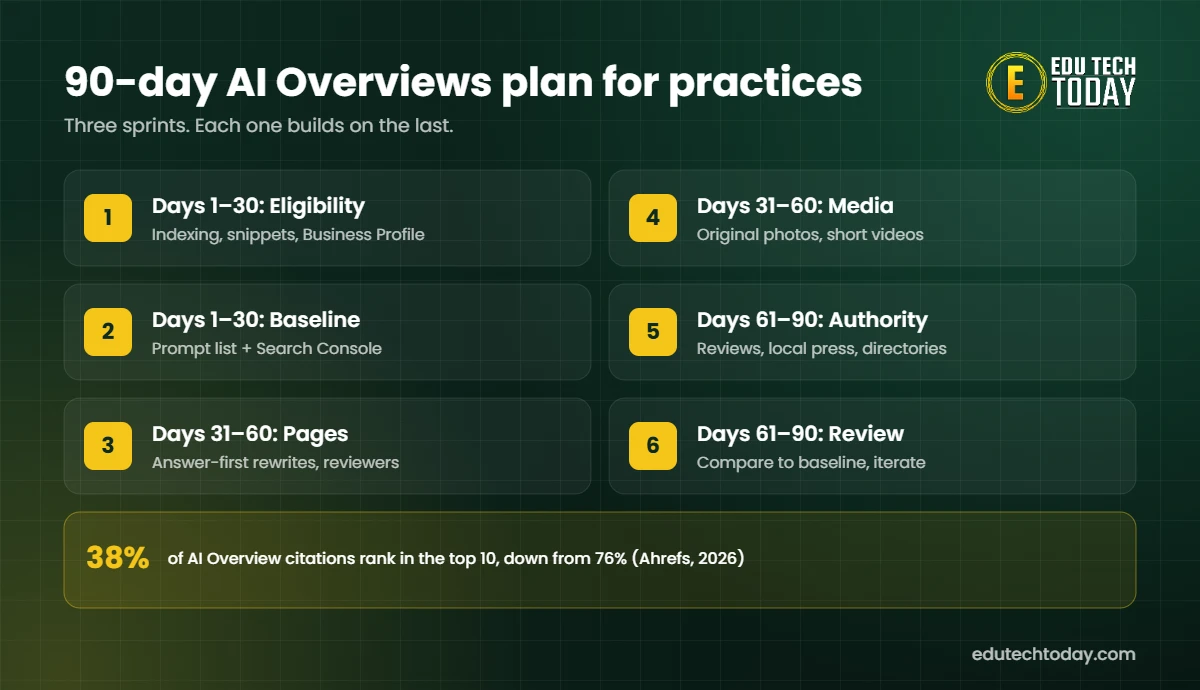
Sprint 1 (days 1–30): Eligibility and baseline
Start by confirming that your key pages are indexed and snippet-eligible. Next, update your Google Business Profile with the right categories, services, insurance details and hours. Then record a baseline: list 20 local patient searches, note which ones show an AI Overview, and see who gets cited. Our Business Profile category finder helps with the first step.
Sprint 2 (days 31–60): Pages and expertise
Next, rewrite your five most important service pages. Open each one with a short, direct answer. Then add a “Medically reviewed by” line with the physician’s name and a link to a full bio. Google also recommends high-quality images and video, so add original photos of your team and office instead of stock images.
Sprint 3 (days 61–90): Authority and review
After that, build outside proof. Ask satisfied patients for reviews, update directory listings, and pursue local press or community mentions. Finally, rerun your baseline searches and compare the results. Our guide to measuring AI visibility shows how to report the change.
How to measure AI Overviews for medical practices
In June 2026, Google introduced generative AI performance reports in Search Console. They show impressions for AI Overviews and AI Mode by page, device, country and date, although clicks are not included yet. Then use the report alongside your manual baseline. Also expect movement, since a 2026 Ahrefs study found that half of AI Overview citations were gone by the next day.
| Signal | Where to check | What good looks like |
|---|---|---|
| Indexing | Search Console | All key service pages indexed |
| AI impressions | Generative AI report | Rising month over month |
| Citations | Manual baseline searches | More local prompts citing you |
| Accuracy | AI Overview text | Correct hours, insurance and providers |
Mistakes that block AI Overviews for medical practices
- Thin service pages. A few lines of text rarely answer a patient’s real question.
- No visible reviewer. Health content without a named expert looks risky.
- Mass-produced pages. Google warns that scaled, near-duplicate pages can break its spam policies.
- Exposing patient details. Never reveal patient information in reviews or testimonials.
For the complete strategy behind this plan, see our healthcare GEO framework.
Frequently asked questions
How do AI Overviews for medical practices choose which clinics to cite?
Google draws on indexed pages, Business Profile data and signals of expertise and trust. Clear answers, accurate listings and strong reviews all improve your chances.
Do medical practices need schema for AI Overviews?
No. Google says structured data is not required for its AI features. It still helps with rich results, so keep accurate markup in place.
Can a new clinic website appear in AI Overviews?
Yes, especially for local and specific searches. Broad health questions are harder, because large health publishers dominate them.
How long do AI Overviews for medical practices take to show results?
Eligibility fixes can show within weeks. Most practices need about three months of content and authority work before citations rise consistently.
Sources
- Google Search Central: Optimizing for generative AI features
- Google Search Central: AI features and your website
- Ahrefs: 38% of AI Overview citations pull from the top 10
- Ahrefs: How stable are AI citations?
- Google Search Central: Search generative AI performance reports
Running a busy practice? See how our physician marketing services handles this work every month, so your team does not have to.
Want to see what ChatGPT and Google say about your practice? Book a free AI visibility audit: a 30-minute call and a 5-page written report.