
Short answer: Content that gets cited by AI opens each section with a direct answer, backs claims with statistics and named sources, and uses clear structure such as question headings, tables and numbered steps. Research from Princeton and IIT Delhi found that adding quotes, statistics and citations can raise a page’s visibility in AI answers by up to about 40%.
I’ve rewritten hundreds of pages for AI search over the past two years, and the pattern is surprisingly consistent. The pages AI tools quote are not the longest or the most “optimized.” Instead, they are the clearest and the best supported. Below are the nine writing rules I now follow on every page, along with the evidence behind each one.
Key takeaways
- AI systems lift short, direct answers, so put the answer before the explanation.
- Statistics, quotations and cited sources are the three edits with the strongest research support.
- Keyword stuffing does not help, and in testing it made AI visibility worse.
- You don’t need to rank first. Lower-ranked pages gained the most from these edits.
- Structure helps both readers and machines: tables, lists and one idea per paragraph.
How do AI tools pick the content that gets cited?
When someone asks ChatGPT, Perplexity or Google’s AI Overviews a question, the system first retrieves a set of pages. Then it reads them and writes a summary, linking to the sources it relied on. Google says its AI features may run several related searches at once, a process it calls query fan-out, to gather a wider set of supporting pages.
So the real question is this: once your page is in that pool, does it contain a passage worth quoting? That is where writing quality wins. In fact, Ahrefs found that only 38% of pages cited in AI Overviews also ranked in Google’s top 10 for the same query. Many citations go to pages that simply answer better.
The 9 rules for content that gets cited by AI
Use these rules as an editing pass on any page you want AI tools to quote. You don’t need all nine on day one, but the first four make the biggest difference.
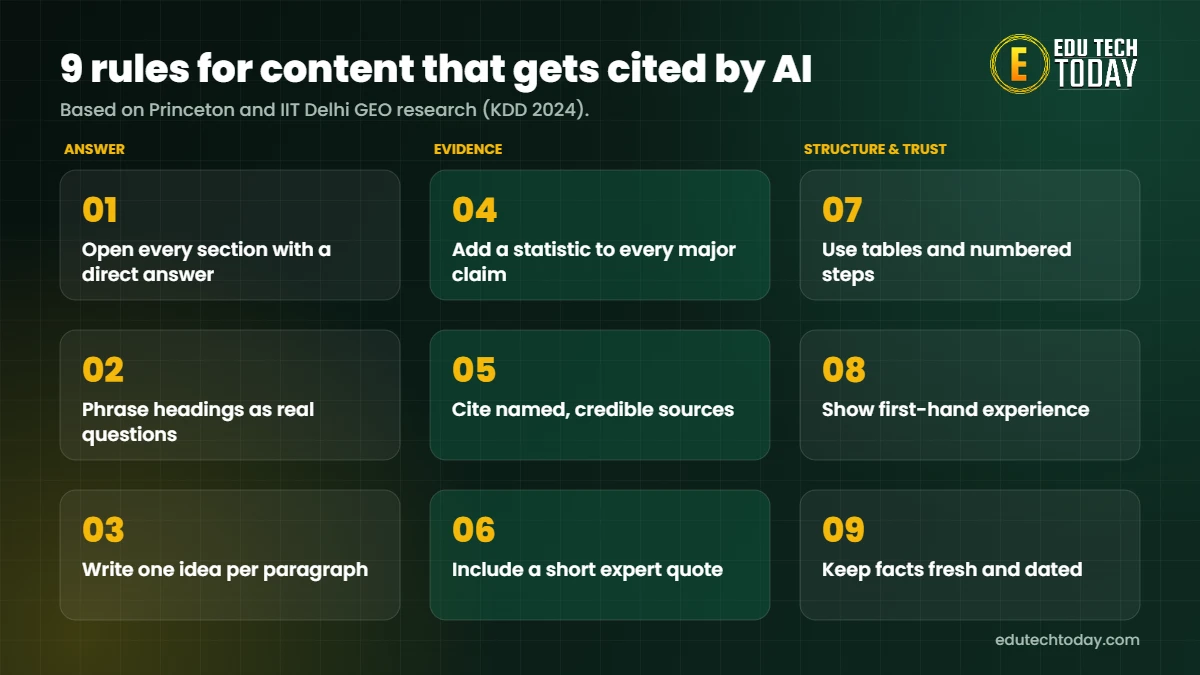
1. Open every section with a direct answer
Answer the heading’s question in the first 40 to 60 words. Then expand. An AI system that is scanning for a quotable passage will usually take the cleanest, most complete sentence near the top of a section.
2. Phrase headings as real questions
Write headings the way people type or speak a query. For example, “How much does medical billing software cost?” works better than “Pricing overview.” Clear questions make it easy to match your section to a user’s prompt.
3. Add a statistic to every major claim
Numbers make a claim concrete and easy to quote. In the Princeton and IIT Delhi study, adding statistics was one of the top three methods for improving visibility in generative engine answers. Always link to the original source of the number.
4. Cite named, credible sources
Name the organization, the study and the year in the sentence itself, not only in a footnote. Citing sources was another top method in the same research. Notably, it raised visibility by more than 115% for a page that started in fifth position.
5. Include a short expert quote
Quotation addition was the single best performer in that study. A one-line quote from a named practitioner, customer or researcher adds authority that paraphrase alone cannot. Keep it short, accurate and attributed.
6. Use tables and numbered steps
Comparisons belong in tables, while processes belong in numbered lists. Both formats are easy for a model to parse and restate. They also help readers who skim, which keeps them on the page longer.
7. Write one idea per paragraph
Short paragraphs of two to four sentences create clean, self-contained passages. As a result, each paragraph can stand alone as an answer, which is exactly what an AI system needs when it builds a summary.
8. Show first-hand experience
Generic advice is everywhere, so AI tools have plenty of it. What they lack is your experience: a client result, a test you ran, a mistake you learned from. Google’s guidance on helpful content asks for exactly this kind of first-hand expertise.
9. Keep facts fresh and dated
Add an “updated” date and review statistics every quarter. Since AI answers often favor current information, an outdated number can quietly cost you a citation.
What doesn’t work for content that gets cited by AI?
Some old habits actively hurt. The same research tested several popular tactics, and the results were clear:
- Keyword stuffing scored below the unedited baseline. On Perplexity, it performed about 10% worse.
- An “authoritative” tone on its own made no meaningful difference. Evidence matters more than confident wording.
- Invented or unsourced statistics are a risk, not a shortcut. If you can’t trace a number, leave it out.
- Special AI files or markup won’t save you. Google states that its AI features need no special schema or new files.
Before and after: rewriting content so it gets cited by AI
Before: “In today’s fast-changing digital landscape, businesses must adapt to new ways people search for information online, and AI is playing an increasingly important role.”
After: “About 68% of US Google searches ended without a click in early 2026, according to SparkToro. So if your page isn’t the one AI tools quote, many buyers will never see it.”
The second version answers faster, adds a number and names its source. Consequently, an AI system is far more likely to lift it into an answer.
Pre-publish checklist for content that gets cited by AI
- Does every H2 open with a direct answer of 60 words or fewer?
- Does each major claim have a statistic or named source?
- Is there at least one table, list or set of numbered steps?
- Have you included one first-hand example or result?
- Does the page name its author, with a short bio?
- Is the “updated” date accurate?
You can test step one in seconds with our free answer block checker. For the bigger picture of where this fits, see our 5-layer AEO and GEO content strategy framework.
Frequently asked questions
How long should content that gets cited by AI be?
Length matters less than coverage and clarity. A focused 1,200-word page that fully answers a question often beats a 3,000-word page that wanders. Cover the whole question cluster, then stop.
Can a new website earn AI Overview citations?
Yes. The GEO research found that lower-ranked pages gained the most from these edits. Still, a new site also needs basic trust signals, such as a named author, consistent business details and some mentions elsewhere online.
Does this work for ChatGPT as well as Google?
Largely, yes. The study also tested Perplexity, a live AI search engine, and saw similar gains. For ChatGPT specifically, our ChatGPT SEO guide covers the extra steps for local businesses.
Should I use AI to write content that gets cited?
AI can help with outlines and first drafts. However, the evidence, examples and expert quotes that earn citations have to come from you. Unedited AI text rarely has them.
Want a team to apply these rules across your site? That is the daily work of our SEO, AEO and GEO content strategy studio. If you serve patients, also read our guide to AI visibility for medical practices, and see why good SEO is already good GEO.
Sources
- GEO: Generative Engine Optimization (Aggarwal et al., Princeton University and IIT Delhi, KDD 2024)
- Ahrefs study on AI Overview citations, reported by DesignRush
- Google Search Central: AI features and your website
- Google Search Central: Creating helpful, reliable, people-first content
- SparkToro zero-click data for 2026, reported by TechWyse
Prefer to have this done for you? Our marketing support for medical practices runs AI visibility, Google Business Profile, reviews and SEO for US physician practices.
Want to know which of your pages AI tools are quoting, and which they skip? Book a free content audit: a 30-minute call and a 5-page written report.