
Short answer: In GEO vs AEO for healthcare, AEO (answer engine optimization) shapes your pages so search and voice tools can lift a clear, direct answer. GEO (generative engine optimization) builds the trust and outside mentions that make AI tools like ChatGPT name your practice. Most practices need both: AEO wins the question, and GEO wins the recommendation.
Marketing teams now hear two new acronyms in every meeting. Some vendors sell AEO, while others sell GEO. Meanwhile, practice owners just want to know which one brings in more patients. The honest answer is that they solve different problems, and each one matters at a different point in the patient journey.
This guide breaks down GEO vs AEO for healthcare in plain language. First, it defines each term. Then it compares them side by side. Finally, it maps both to the patient journey, so you can decide where to spend your next dollar.
Key takeaways
- AEO focuses on page structure, so a tool can quote a short, accurate answer.
- GEO focuses on trust signals, so AI tools feel confident naming your practice.
- Symptom and insurance questions lean on AEO, while provider choice leans on GEO.
- Both rest on the same base: accurate facts, real expertise and crawlable pages.
What AEO means for healthcare
Answer engine optimization grew out of featured snippets and voice search. Its goal is therefore simple: give one clear answer to one clear question. For a clinic, that might mean a service page that opens with “Yes, we treat plantar fasciitis without surgery, using physical therapy, custom orthotics and injections.”
In practice, AEO work is mostly on-page. It includes direct answers at the top of each page, question-based headings, short paragraphs and FAQ sections. Because of that, a small team can see AEO gains quickly. You can test an opening paragraph with our free answer block checker.
What GEO means for healthcare
Generative engine optimization, however, goes further. AI tools like ChatGPT, Perplexity and Google AI Overviews write new answers from many sources. So they do not just quote a page; they decide which practices deserve a mention. GEO is the work of earning that mention.
GEO depends heavily on signals outside your website. These include consistent directory listings, reviews, hospital affiliations, local press and specialty association pages. For example, a practice with strong reviews across three directories often beats a practice with a beautiful website and no outside proof. Our healthcare GEO framework lays out the full seven-step process.
GEO vs AEO for healthcare: side-by-side comparison
| Factor | AEO | GEO |
|---|---|---|
| Main goal | Get your answer quoted | Get your practice named and cited |
| Where the work happens | Mostly on your website | Website plus third-party sites |
| Key tactics | Direct answers, FAQs, clear headings | Entity consistency, reviews, mentions |
| Typical speed | Weeks | Two to four months |
| Best for | Symptom, cost and insurance questions | “Best doctor near me” questions |
How GEO vs AEO for healthcare plays out in the patient journey
Patients usually move through several stages before they book. Each stage favors a different approach, as the map below shows.
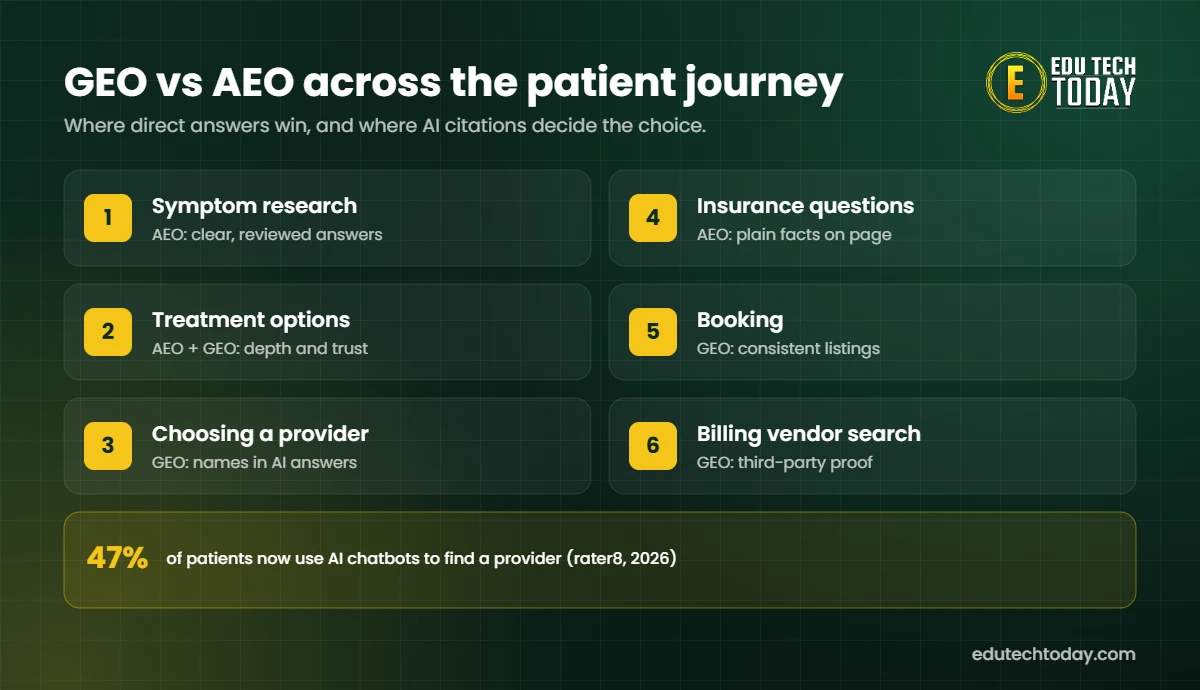
Symptom research favors AEO
Early on, patients ask “what causes” and “how to treat” questions. Large publishers like Mayo Clinic usually win broad versions of these. However, a specialty practice can still win narrow, local versions with clear, medically reviewed answers.
Choosing a provider favors GEO
Later, patients ask “who is the best orthopedic surgeon near me?” At this stage, AI tools also compare reputations across many sources. This is where GEO matters most. In fact, a 2026 rater8 survey found that AI swayed 36% of patients’ provider decisions, slightly ahead of Google search at 34%.
Insurance and billing questions need both
For example, questions like “Does this clinic accept Aetna?” need an exact answer on your page, which is AEO. At the same time, AI tools cross-check that answer with directories, which is GEO. So keep insurance lists current everywhere.
GEO vs AEO for healthcare: which matters more?
For most practices, GEO vs AEO for healthcare is not an either-or choice. Still, your starting point depends on where you lose patients today.
- Start with AEO if your service pages are thin or bury the answer under long introductions.
- Start with GEO if your pages are solid but ChatGPT names competitors instead of you.
- Run both together if you are launching a new location or specialty line.
If ChatGPT already skips you, our guide on why ChatGPT leaves practices out walks through a seven-point diagnosis.
What Google says about GEO vs AEO for healthcare
Fortunately, Google’s own guidance keeps things grounded. First, it states that pages need to be indexed and eligible for a snippet to appear in its AI features. It also says no special markup or AI text file is required. Instead, it recommends original, people-first content with real expertise. In other words, AEO and GEO work best when they rest on solid SEO basics, not on shortcuts.
Frequently asked questions
What is the difference in GEO vs AEO for healthcare?
AEO structures pages so tools can quote a direct answer. GEO builds the trust and third-party proof that makes AI tools recommend your practice by name.
Is AEO still relevant with AI Overviews?
Yes. AI Overviews still pull from indexed pages, and clear, direct answers make your page easier to use as a source.
Do billing companies need GEO or AEO?
Both. Billing companies win vendor searches through GEO signals like reviews and case studies, while AEO helps them answer detailed process questions.
Can one agency handle GEO and AEO for healthcare together?
Yes, and it usually works better. The two share the same content and data, so splitting them across vendors often creates conflicting facts.
Sources
- Google Search Central: Optimizing for generative AI features
- Ahrefs: 38% of AI Overview citations pull from the top 10
- TechTarget: Almost half of patients use AI for online provider search
Prefer to have this done for you? Our medical practice marketing agency runs AI visibility, Google Business Profile, reviews and SEO for US physician practices.
Want to see what ChatGPT and Google say about your practice? Book a free AI visibility audit: a 30-minute call and a 5-page written report.