
Short answer: If ChatGPT is not citing your practice, the cause is usually one of seven gaps: blocked crawl access, inconsistent practice details, too few third-party mentions, content AI cannot extract, stale pages, weak page authority, or pages that do not match real patient questions. Check them in that order, because the first failed check is usually the real problem.
You asked ChatGPT for the best dermatologist in your city. It named three competitors and left you out. That moment is frustrating, especially when you know your outcomes and reviews are strong. However, it is also fixable once you know where to look.
This matters more each month. A 2026 rater8 survey found that 47% of patients now use AI chatbots to find a provider, up from 31% at the end of 2025. So when ChatGPT is not citing your practice, you lose patients before they ever see your website. This guide walks through a seven-point diagnosis, explains why each gap matters, and shows how to fix it.
Key takeaways
- ChatGPT search relies on its own crawler, OAI-SearchBot, so blocking it removes you from search answers.
- Consistent details across your site and directories help ChatGPT recognize your practice as one entity.
- Third-party mentions often matter more than your own pages for “best doctor” prompts.
- Citations shift daily, so test a fixed set of prompts over time instead of trusting one answer.
What ChatGPT checks before citing your practice
When ChatGPT searches the web, it pulls pages that its search crawler has indexed. Then it summarizes what several sources agree on. As a result, it favors practices that are easy to find, easy to verify and mentioned by more than one trusted site.
It also helps to know the bots involved. OpenAI’s documentation separates three crawlers. GPTBot collects data for model training. OAI-SearchBot powers ChatGPT search. ChatGPT-User fetches pages when a person asks ChatGPT to visit them. Therefore, blocking GPTBot does not remove you from search, but blocking OAI-SearchBot does.
7 reasons ChatGPT is not citing your practice
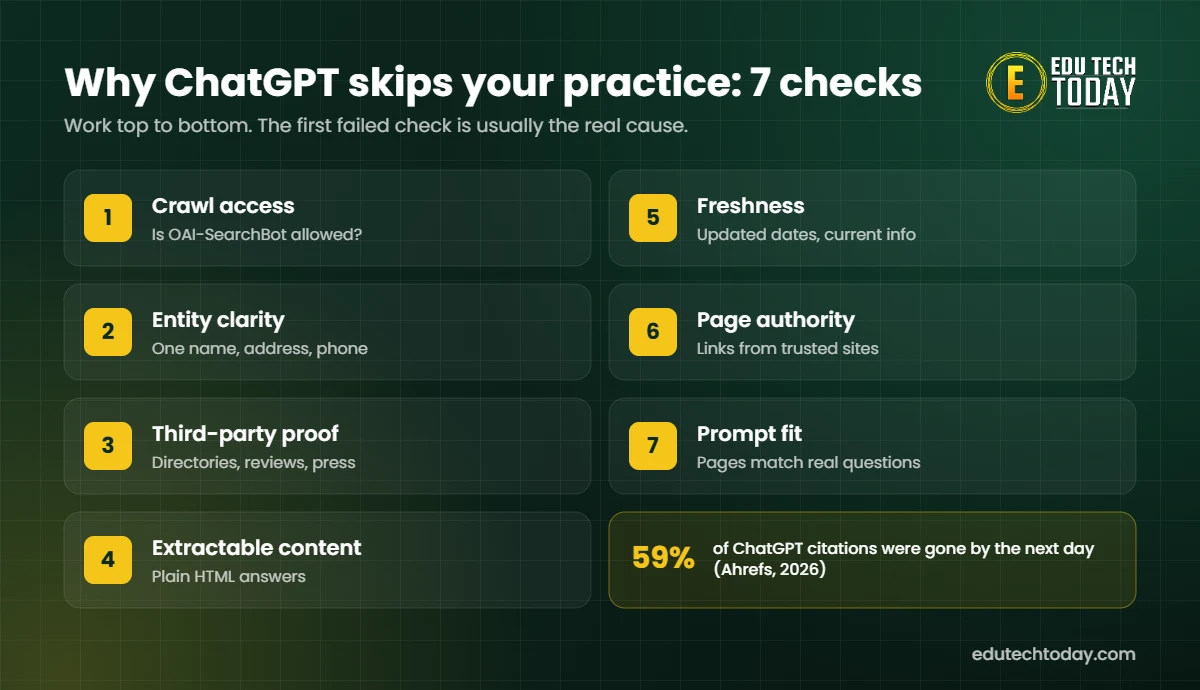
Work through these checks from top to bottom. Each one takes between ten minutes and an afternoon.
1. OAI-SearchBot cannot reach your site
Open yoursite.com/robots.txt and look for rules that block OAI-SearchBot or all bots. Also ask your host whether a firewall or security plugin blocks unknown crawlers. Many healthcare sites run strict security tools, and some of them block AI bots by default. If you need a clean file, use our free AI robots.txt generator. Keep in mind that OpenAI says robots.txt changes can take about 24 hours to apply.
2. Your practice details do not match
ChatGPT compares your website with directories such as Healthgrades, Zocdoc, Vitals and your Google Business Profile. When the name, address or phone number differs, it cannot be sure these listings describe the same practice. For example, “Smith Family Medicine” on one site and “Smith FM Clinic” on another weakens the link. So pick one exact version and use it everywhere.
3. Too few third-party mentions
This is the most common reason ChatGPT is not citing your practice. ChatGPT rarely trusts a practice on its own word. Instead, it looks for agreement across reviews, local news, hospital affiliation pages, specialty associations and “best of” lists. If your practice appears only on your own website, you are easy to skip.
4. Your content is hard to extract
AI tools read text, not design. If your services, insurance plans or provider names sit inside images, sliders or scripts, ChatGPT may never see them. Instead, put key facts in plain HTML, and open each service page with a short, direct answer. Our answer block checker scores that opening paragraph for you.
5. Your pages look stale
Old provider lists, outdated hours and pages last edited years ago send a weak signal. Meanwhile, competitors who update often look more reliable. Add visible “last updated” dates, and review your top pages every quarter.
6. Your pages lack authority
Even a perfect page can be ignored when no other trusted site links to it. Local business groups, hospital partners and medical associations are good sources of links. Also, link your own pages together, so service pages connect to provider bios and location pages.
7. Your pages do not match patient questions
Patients ask conversational questions, such as “Which pediatric dentist near me takes Medicaid?” If no page on your site answers that kind of question, ChatGPT has nothing to quote. Our ChatGPT prompt finder helps you list the questions patients actually ask.
Quick table: is ChatGPT citing your practice?
| Check | How to test it | Typical fix |
|---|---|---|
| Crawl access | Read robots.txt and firewall rules | Allow OAI-SearchBot |
| Entity data | Compare five listings side by side | Standardize name, address, phone |
| Mentions | Search your name plus specialty | Claim directories, earn local press |
| Extractability | Disable JavaScript and reload | Move facts into plain text |
| Prompt fit | Ask ChatGPT ten patient questions | Write pages that answer them |
How to test whether ChatGPT is citing your practice
Do not judge results by one answer. A 2026 Ahrefs study found that 59% of ChatGPT citations were gone by the next day. So build a list of 20 to 30 prompts that mix specialty, city and insurance. Then run the same list every month in a logged-out browser, and record who gets named.
Keep this testing free of patient data. Never paste names, dates of birth or chart details into ChatGPT, because that can create a HIPAA problem. Use general questions that any patient might ask instead. For the full system behind these fixes, read our seven-part GEO framework for practices.
What to fix first when ChatGPT is not citing your practice
Start with crawl access and entity data, since both are fast and free. Next, rewrite your top three service pages with direct answers. After that, spend steady effort on reviews, directories and local mentions. Most practices see changes in two to four months, although results vary by market and specialty.
Frequently asked questions
Why is ChatGPT not citing your practice when Google ranks you well?
Google rankings and ChatGPT answers use different signals. ChatGPT leans more on third-party mentions and consistent entity data, so a well-ranked page can still be left out.
Does blocking GPTBot stop ChatGPT from citing my site?
No. GPTBot is for model training. ChatGPT search uses OAI-SearchBot, which you control with a separate robots.txt rule.
How long until ChatGPT starts citing your practice?
Crawl fixes can apply within a day or two. Authority and mention work usually takes two to four months before answers change consistently.
Can I pay to get my practice cited by ChatGPT?
No. Organic ChatGPT answers are not for sale. You earn citations through access, accuracy, useful content and trusted mentions.
Sources
- OpenAI: Overview of OpenAI crawlers
- Ahrefs: How stable are AI citations?
- TechTarget: Almost half of patients use AI for online provider search
- rater8: 2026 Patient Choice Report
Running a busy practice? See how our physician marketing services handles this work every month, so your team does not have to.
Want to see what ChatGPT and Google say about your practice? Book a free AI visibility audit: a 30-minute call and a 5-page written report.