

Short answer: Perplexity SEO for medical practices means making your site easy for Perplexity AI to crawl, trust and cite. Allow PerplexityBot, keep service pages fresh and specific, show provider credentials, link to reliable clinical sources, keep your listings consistent, and test a fixed set of 30 patient prompts every month.
Perplexity works differently from a classic search engine. Instead of ten blue links, it writes an answer and shows its sources as numbered citations. For a practice, that citation is valuable, because it sends patients straight to the page that answered their question.
The good news is that Perplexity often rewards specific, well-organized pages, even from smaller sites. So Perplexity SEO for medical practices is one of the more realistic AI wins for a new or local practice. This guide covers how Perplexity finds sources, what to change on your site, and how to measure progress.
Key takeaways
- PerplexityBot must be allowed in robots.txt and your firewall, or Perplexity cannot index you.
- Fresh, specific pages with clear facts tend to earn more citations than generic articles.
- Visible credentials and linked clinical sources build trust for health questions.
- A fixed 30-prompt test shows whether your work is moving the needle.
How Perplexity chooses sources
Perplexity uses two fetchers. PerplexityBot crawls and indexes sites for its search results. Perplexity-User visits pages when someone asks a question that needs them. According to Perplexity’s documentation, PerplexityBot follows robots.txt and is not used to train AI models.
When it builds an answer, Perplexity looks for passages that answer the question directly and that other sources support. As a result, a page that clearly states “We treat adult ADHD, accept Blue Cross, and offer telehealth visits in Ohio” is easy to cite. By contrast, a vague page about “comprehensive care” gives it little to work with.
Perplexity SEO for medical practices: the 7-point audit
Score your site on each item from 0 to 2. Then fix anything under 2 before you publish new content.
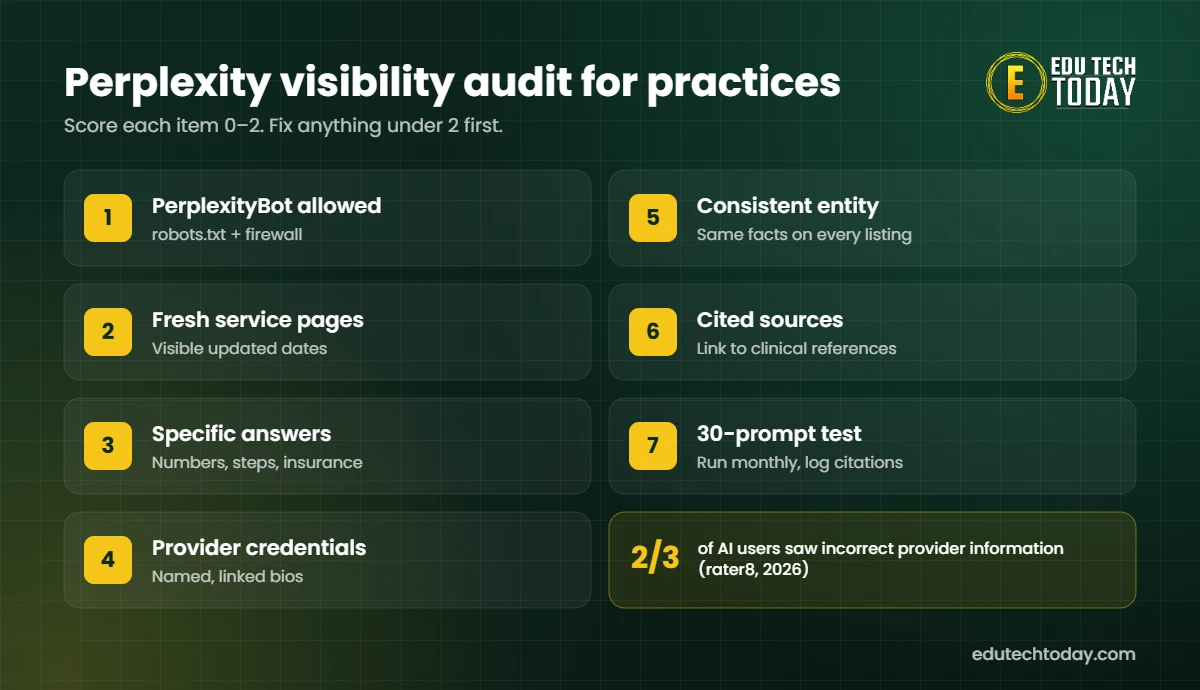
1. Allow PerplexityBot
Check robots.txt for rules that block PerplexityBot or all bots. Also ask your host whether a firewall blocks it. Perplexity publishes its crawler IP ranges, so your host can safely allow them. Our AI robots.txt generator handles the file itself.
2. Keep service pages fresh
Add a visible “last updated” date and a named medical reviewer to each service page. Then review your top pages every quarter. Fresh pages signal that your information is current, which matters when patients ask about insurance or availability.
3. Give specific answers
Replace general claims with facts. For example, list the insurance plans you accept, typical wait times for new patients, and the steps of a first visit. In addition, open each page with a two- or three-sentence answer to its main question.
4. Show provider credentials
Name the physician who reviewed each page, and link to a full bio with training, board certification and years in practice. Health answers carry risk, so these details help Perplexity choose you over an anonymous page.
5. Keep your entity consistent
Make sure your name, address, phone and providers match across your site, Google Business Profile and major directories. Otherwise, conflicting details can lead Perplexity to cite a directory instead of you.
6. Cite reliable clinical sources
Link to trusted references, such as CDC pages or specialty society guidelines, when you explain conditions or treatments. This shows your content rests on solid evidence. Similarly, it gives Perplexity confidence that your page agrees with authoritative sources.
7. Run a 30-prompt test
Build 30 patient questions that mix specialty, city and insurance. Next, run them in Perplexity every month, and log whether your practice is cited. Our prompt finder helps you write the list.
Content formats that work for Perplexity SEO for medical practices
Some page types earn citations more often than others. In particular, these formats suit patient questions well:
- Insurance and cost pages with clear lists of accepted plans and what a visit usually costs.
- Condition pages with a direct answer, treatment options and a reviewer byline.
- “What to expect” pages that walk through a first visit step by step.
- Comparison pages that explain options, such as physical therapy versus surgery.
Common mistakes with Perplexity SEO for medical practices
Many practices block AI bots by accident through security plugins. Others publish long, generic articles that never answer a specific question. Some also forget to update provider lists after staff changes. Each mistake is easy to fix, yet together they explain why many strong practices never appear in Perplexity answers.
Also, keep patient privacy in mind. Never publish testimonials or case details that could identify a patient without written authorization, since that can breach HIPAA.
Where Perplexity SEO for medical practices fits
Perplexity is one engine among several. The same basics also help with ChatGPT and Google AI Overviews. For the full system, read our healthcare GEO framework. Then use our technical checklist for AI-ready medical sites to tighten crawl access and page structure.
Frequently asked questions
Where should Perplexity SEO for medical practices start?
Start by allowing PerplexityBot. Next, write specific answer-first pages, show reviewer credentials and keep listings consistent. Then test your key prompts monthly to see what changes.
Does Perplexity crawl healthcare websites?
Yes. PerplexityBot crawls sites that allow it in robots.txt. Perplexity says changes to those rules can take up to 24 hours to apply.
Is Perplexity SEO for medical practices different from Google SEO?
It overlaps a lot. However, Perplexity places more weight on clear, quotable passages and visible sources, while Google also leans on rankings and its Business Profile data.
How long does Perplexity SEO for medical practices take to work?
Crawl fixes can show within days. Content and trust improvements usually take several weeks to a few months to change citations consistently.
Sources
- Perplexity: Perplexity crawlers
- rater8: 2026 Patient Choice Report
- TechTarget: Almost half of patients use AI for online provider search
Prefer to have this done for you? Our done-for-you practice marketing runs AI visibility, Google Business Profile, reviews and SEO for US physician practices.
Want to see what ChatGPT and Google say about your practice? Book a free AI visibility audit: a 30-minute call and a 5-page written report.