
Short answer: ChatGPT citations for doctors come mostly from trusted third-party sources, not from a practice’s own website alone. To earn them, run a citation gap audit: list real patient prompts, log which doctors and sources ChatGPT names, then claim, correct and earn mentions on those same sources. Re-test monthly, since ChatGPT’s citations change often.
Doctors often assume ChatGPT picks the “best” physician. In reality, it repeats what trusted sources say about physicians. So if directories, hospital pages, local news and review sites describe a colleague clearly but say little about you, ChatGPT will name the colleague.
That is good news, because it means ChatGPT citations for doctors are earnable. You cannot buy them, but you can work on the exact sources ChatGPT already trusts. This guide shows you how, using a five-step citation gap audit that any practice can run.
Key takeaways
- ChatGPT search relies on its OAI-SearchBot crawler and favors sources that agree with each other.
- A citation gap audit shows which sources ChatGPT uses for your specialty and city.
- Earned mentions on directories, hospital sites and local media often matter more than new blog posts.
- Citations shift daily, so measure mention rate over months, not single answers.
Where ChatGPT citations for doctors come from
When a patient asks “Who is the best cardiologist in Phoenix?”, ChatGPT searches the web through pages that OAI-SearchBot has indexed. Then it summarizes what several sources agree on. Typically, those sources include physician directories, hospital profiles, health system pages, local “top doctors” lists and review platforms.
This is why your own website is necessary but not enough. It proves who you are. However, other sites prove that people trust you. ChatGPT needs both before it will confidently name a doctor.
Why ChatGPT citations for doctors are hard to keep
Citations are not permanent. In a 2026 study, Ahrefs found that 59% of ChatGPT citations disappeared by the next day, and only 13% lasted a week or more. As a result, the goal is not one perfect answer. Instead, the goal is to appear in a growing share of answers over time.
Patients also notice errors. A 2026 rater8 survey found that two-thirds of AI users had seen incorrect provider information. So accurate details across every source protect both your visibility and your reputation.
The citation gap audit: 5 steps
This audit takes about half a day the first time. After that, a monthly re-test takes around an hour.
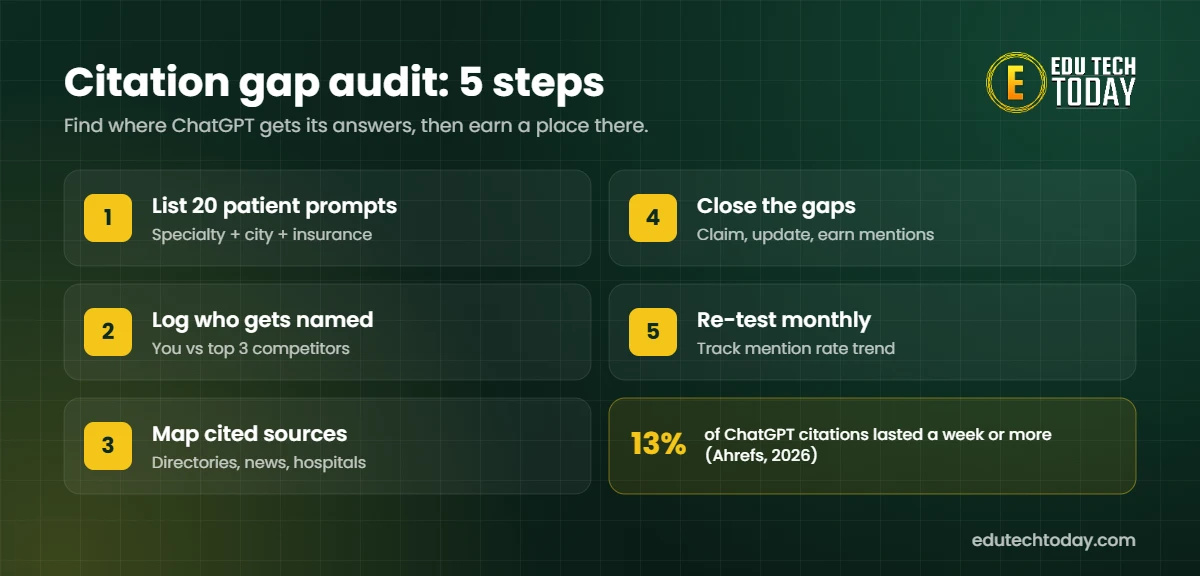
1. List 20 patient prompts
Write questions that combine your specialty, city and common insurance plans. For example, “best pediatric ENT in Denver that takes Kaiser.” Our ChatGPT prompt finder speeds this up. Keep every prompt general, and never include patient details.
2. Log who gets named
Run each prompt in ChatGPT using a logged-out browser. Then record which doctors appear, in what order, and whether your name shows up. Also note your top three competitors.
3. Map the cited sources
Next, open the citations ChatGPT shows. List every source, such as Healthgrades, a hospital profile, a local magazine or a specialty society directory. Patterns appear quickly, because the same few sources usually repeat across prompts.
4. Close the gaps
For each source, ask a simple question: are you listed, accurate and well described? Then act. Claim missing profiles, correct outdated details, request reviews on platforms that matter, and pitch local media with a useful story. In addition, ask your hospital to update your affiliation page with current specialties and photos.
5. Re-test monthly
Finally, run the same prompts each month and track your mention rate. Our guide on how to track AI visibility includes a simple scorecard for this.
Sources that often drive ChatGPT citations for doctors
| Source type | Examples | What to do |
|---|---|---|
| Physician directories | Healthgrades, Vitals, Zocdoc, WebMD | Claim and complete every profile |
| Hospital and health system pages | Affiliation and “find a doctor” pages | Ask for current bios and specialties |
| Local media | City magazines, local news health stories | Offer expert quotes and patient tips |
| Professional bodies | Specialty societies, state associations | Keep membership listings current |
| Your own website | Provider bios and service pages | Match details everywhere else |
Common mistakes doctors make
- Blocking OAI-SearchBot. OpenAI says blocked sites will not appear in ChatGPT search answers.
- Chasing volume over accuracy. Ten inconsistent listings help less than five accurate ones.
- Buying fake reviews. They break platform rules and can trigger FTC penalties.
- Replying to reviews with patient details. Confirming someone is a patient can violate HIPAA.
If ChatGPT names you rarely or never, start with our seven-point guide on why ChatGPT skips some practices. For hands-on help, see our ChatGPT recommendation service.
Frequently asked questions
How do doctors earn ChatGPT citations?
Doctors earn them by being accurately described on the sources ChatGPT trusts, such as directories, hospital pages and local media, and by keeping their own website consistent with those sources.
Does ChatGPT cite local medical practices?
Yes. For “near me” and city-based questions, ChatGPT often names local practices, usually based on directories, reviews and local coverage.
Why do ChatGPT citations for doctors change so often?
ChatGPT rebuilds answers each time and draws on different sources. Ahrefs found most ChatGPT citations changed within a day, so trends matter more than single answers.
Can doctors pay for ChatGPT citations?
No. Organic ChatGPT answers are not for sale. Doctors earn citations through accurate listings, trusted mentions and helpful content.
Sources
- OpenAI: Overview of OpenAI crawlers
- Ahrefs: How stable are AI citations?
- TechTarget: Almost half of patients use AI for online provider search
- rater8: 2026 Patient Choice Report
Prefer to have this done for you? Our medical practice marketing agency runs AI visibility, Google Business Profile, reviews and SEO for US physician practices.
Want to see what ChatGPT and Google say about your practice? Book a free AI visibility audit: a 30-minute call and a 5-page written report.