
Short answer: Medical practice schema markup is structured data, usually written in JSON-LD, that tells search engines and AI tools exactly who your practice is, where it is, who your providers are and what you treat. Use MedicalClinic on location pages, IndividualPhysician on provider bios and FAQPage on visible FAQs. Schema helps machines read your facts, but it does not earn AI citations on its own.
Schema markup has become the most oversold tactic in AI search. For example, some vendors promise that one block of code will get your clinic into ChatGPT. That is not true, and the data now shows it clearly. Still, correct schema remains a smart, low-cost step, as long as you know what it can and cannot do.
This guide gives you copy-paste templates for medical practice schema markup. It also explains where each type belongs, how to test it, and which mistakes cause problems. Finally, it sets honest expectations, so you can explain the value to a practice owner.
Key takeaways
- Use JSON-LD, the format Google recommends, and place it in the page head or body.
- Match markup to visible content, because marking up hidden facts can trigger penalties.
- IndividualPhysician now exists on schema.org for single practitioners, with fields like usNPI.
- A 2026 Ahrefs test of 1,885 pages found no meaningful AI citation lift from adding schema alone.
What medical practice schema markup can and cannot do
In simple terms, schema works like a labeled form for machines. Instead of guessing that “Suite 210” is part of an address, a crawler reads it from a clearly marked field. As a result, search engines can display rich results and connect your listings more reliably.
However, schema does not make a page more trustworthy. In May 2026, Ahrefs compared 1,885 pages that added JSON-LD with matched pages that did not. ChatGPT and Google AI Mode citations rose by about 2%, which was statistically indistinguishable from zero. Google’s own guidance also says there is no special markup for its AI features. So treat schema as plumbing that supports good content, not as a ranking shortcut.
Where each medical practice schema markup type belongs
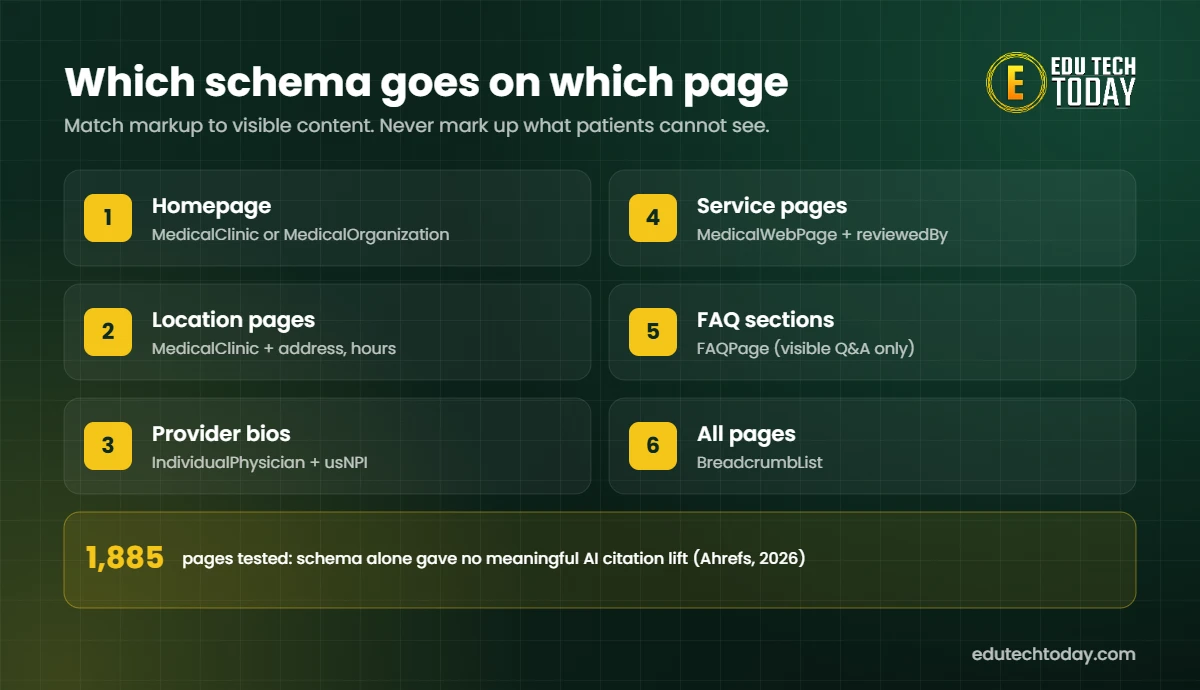
Different pages, however, need different types. The map below shows a simple setup for most practices.
Template 1: MedicalClinic for location pages
First, use this on your homepage or each location page. Then replace every value with your real details, and keep them identical to your Google Business Profile.
{
  "@context": "https://schema.org",
  "@type": "MedicalClinic",
  "name": "Example Family Clinic",
  "url": "https://www.example.com/",
  "telephone": "+1-512-555-0100",
  "address": {
    "@type": "PostalAddress",
    "streetAddress": "100 Main Street, Suite 210",
    "addressLocality": "Austin",
    "addressRegion": "TX",
    "postalCode": "78701",
    "addressCountry": "US"
  },
  "medicalSpecialty": "https://schema.org/PrimaryCare",
  "isAcceptingNewPatients": true,
  "openingHoursSpecification": [{
    "@type": "OpeningHoursSpecification",
    "dayOfWeek": ["Monday","Tuesday","Wednesday","Thursday","Friday"],
    "opens": "08:00",
    "closes": "17:00"
  }],
  "sameAs": ["https://www.healthgrades.com/your-listing"]
}
Our free local business schema generator builds a similar block from a short form.
Template 2: IndividualPhysician for provider bios
Schema.org added IndividualPhysician for single practitioners. It inherits useful fields, including usNPI for the 10-digit National Provider Identifier. Also, it adds practicesAt, which links the doctor to your clinic.
{
  "@context": "https://schema.org",
  "@type": "IndividualPhysician",
  "name": "Dr. Jane Rivera, MD",
  "url": "https://www.example.com/providers/jane-rivera/",
  "medicalSpecialty": "https://schema.org/Dermatology",
  "usNPI": "0000000000",
  "practicesAt": {
    "@type": "MedicalClinic",
    "name": "Example Family Clinic",
    "url": "https://www.example.com/"
  }
}
However, only publish an NPI that already appears on the bio page, and double-check it against the NPPES registry.
Template 3: FAQPage for visible questions
Similarly, add FAQPage only when the questions and answers appear on the page. Keep answers short and factual, and avoid medical advice that a reviewer has not approved.
{
  "@context": "https://schema.org",
  "@type": "FAQPage",
  "mainEntity": [{
    "@type": "Question",
    "name": "Do you accept Aetna?",
    "acceptedAnswer": {
      "@type": "Answer",
      "text": "Yes. We accept most Aetna PPO and HMO plans."
    }
  }]
}
How to test your medical practice schema markup
First, run each page through Google’s Rich Results Test. Next, check the Schema Markup Validator for errors that Google does not flag. Then review Search Console’s enhancement reports every month. Finally, compare the markup with the visible page, because mismatches are the most common problem.
Common mistakes to avoid
- Marking up hidden content. Every fact in your schema should be visible to patients.
- Conflicting plugins. Two SEO plugins can output duplicate or competing blocks.
- Stale details. Old hours or departed providers in schema send mixed signals.
- Fake reviews in markup. Self-written ratings break Google’s guidelines and erode trust.
Overall, schema is one step in a larger system. For the rest of that system, read our healthcare GEO framework. To see whether your work moves the needle, use our guide on measuring AI visibility each month.
Frequently asked questions
Does medical practice schema markup help ChatGPT cite my site?
Not directly. Ahrefs found no meaningful citation lift from adding schema alone. Schema helps machines read your facts, while authority and content earn the citation.
Should I use MedicalClinic or MedicalOrganization?
Use MedicalClinic for a physical location patients visit. MedicalOrganization fits a broader group, such as a multi-site practice or a billing company.
Which schema type should a provider bio use?
Use IndividualPhysician for a single doctor. Link it to your clinic with practicesAt, and keep the details identical to the visible bio.
Can medical practice schema markup hurt my site?
Yes, if it is misleading. Marking up hidden facts or fake reviews can lead to manual actions, so keep every field accurate and visible.
Sources
- Schema.org: MedicalClinic
- Schema.org: Physician
- Ahrefs: Adding schema did not increase AI citations
- Google Search Central: Optimizing for generative AI features
- Google: Rich Results Test
Prefer to have this done for you? Our marketing support for medical practices runs AI visibility, Google Business Profile, reviews and SEO for US physician practices.
Want to see what ChatGPT and Google say about your practice? Book a free AI visibility audit: a 30-minute call and a 5-page written report.